
How Hard Is It to Find a Remote Python Data Job? I Checked 88,975 Hacker News Job Posts
Every month since 2011, Hacker News has run the same thread: Ask HN: Who is hiring? One comment per company, no recruiters, no algorithm. Fourteen years of those threads form one of the few long, consistent records of what tech companies were actually asking for.
I pulled 88,975 comments from 163 monthly threads, from December 2012 through August 2026, and built a funnel app on top of them. You start with every post in a year, then add one requirement at a time and watch the number fall.
Here is what the default search looks like:
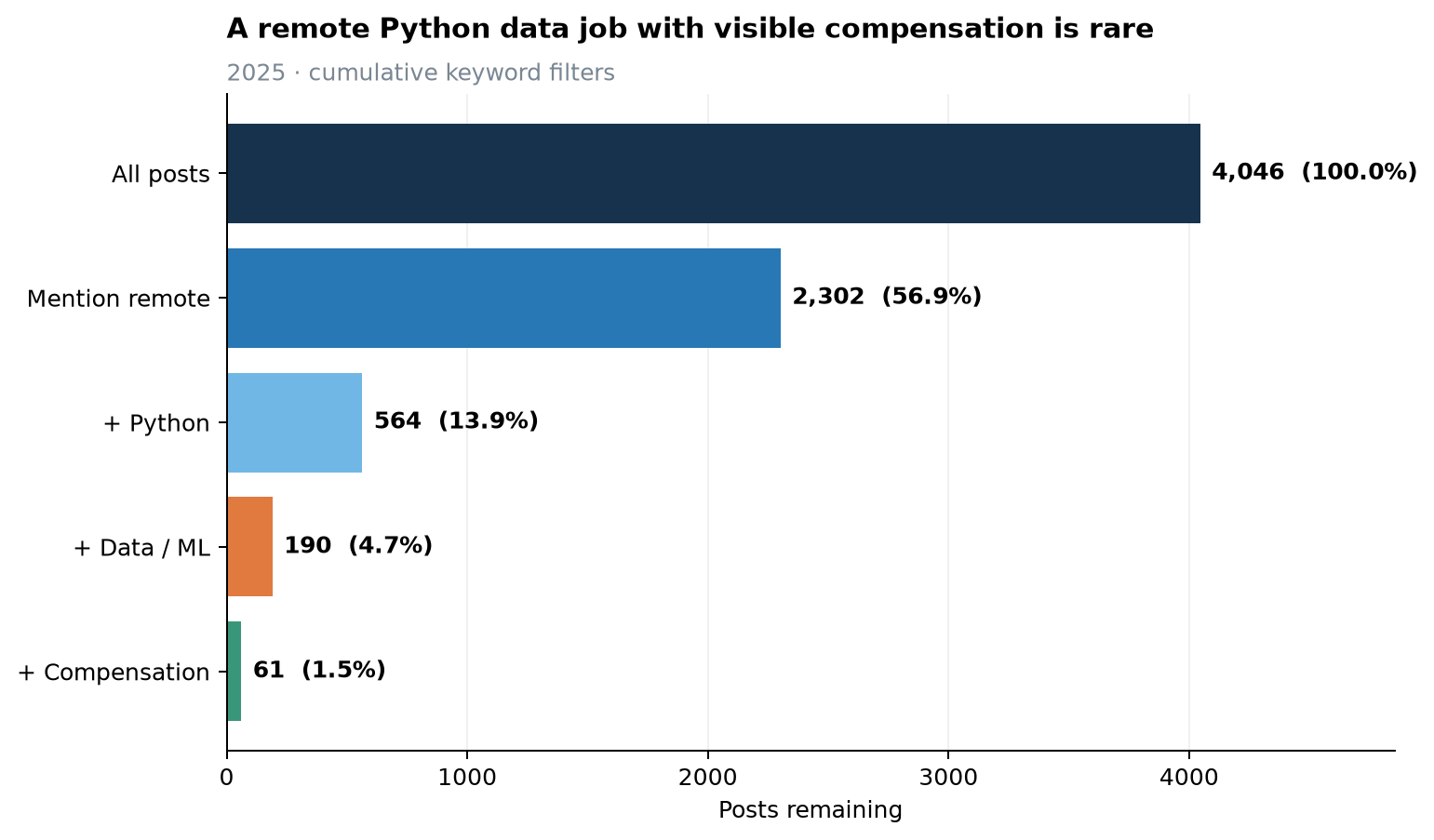
Sixty-one posts out of more than four thousand. That is 1.5%, and each filter is generous. “Remote” only has to appear somewhere in the text. The last step accepts a currency symbol followed by a number, or the words “compensation” or “comp.”
The interesting part is not the final number. Each step has moved in a different direction over the last decade, and two moved in the opposite direction from what I expected.
Step 0: There are half as many jobs
Before any filter runs, the starting pile has changed size.
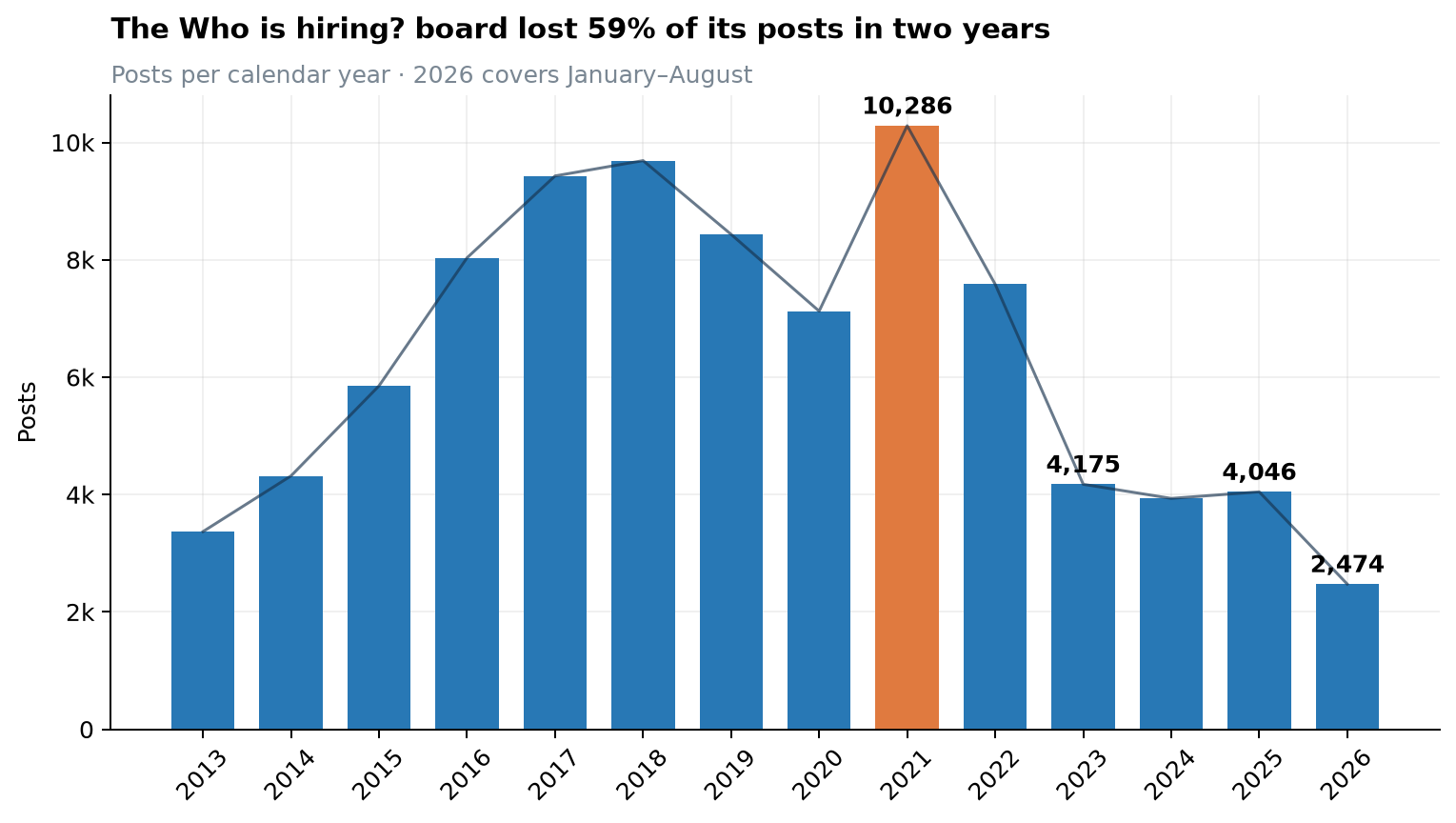
The board peaked at 10,286 posts in 2021 and fell to 4,175 by 2023, a 59% drop in two years. It has been flat at roughly 4,000 a year ever since. Based on January through August, 2026 is on pace for about 3,700.
This is not a formatting artifact. The median post is the same length it was in 2015, about 950 characters. Among the completed years, every year has all 12 monthly threads except 2015, which is missing two. There are simply fewer companies posting.
Step 1: Remote peaked in 2022 and has retreated since
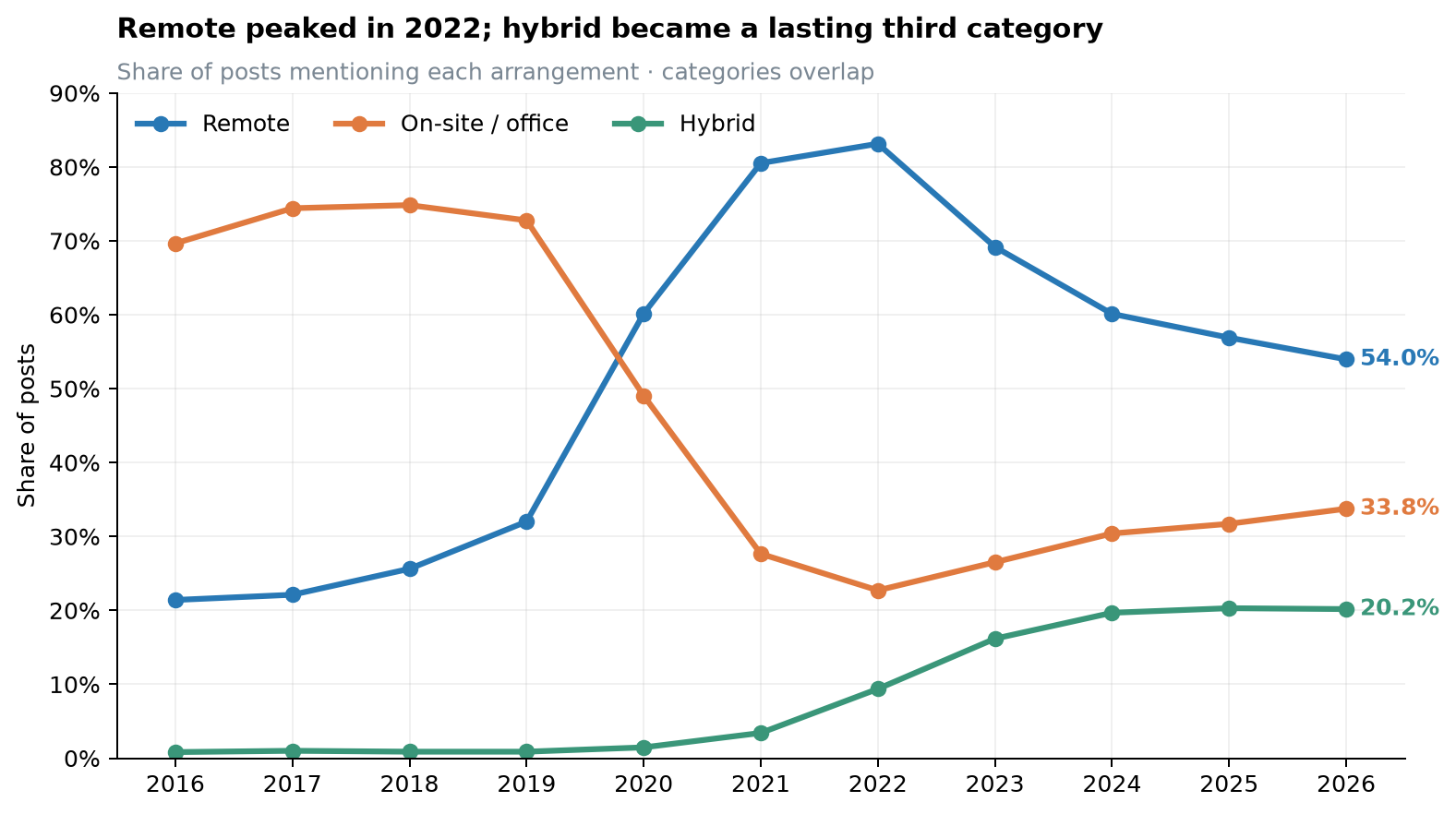
This is the cleanest signal in the dataset. Remote sat around 21% for years, jumped to 60% in 2020, hit 83% in 2022, and has fallen every year since. It is down to 54% in 2026. On-site mentions bottomed out at about 23% in 2022 and have climbed back to 34%.
Hybrid is the real story. It was almost nonexistent before 2020, appearing in under 1% of posts for eight straight years. Now it appears in one post in five. Return-to-office did not undo remote work. It created a third category and took share from both sides.
One caveat is worth stating: the “Company | Location | ONSITE/REMOTE” template only became common around 2015–2016. Before that, work arrangements were buried in prose and were probably undercounted. That is why this chart begins in 2016.
Step 2: Python and JavaScript held their ground
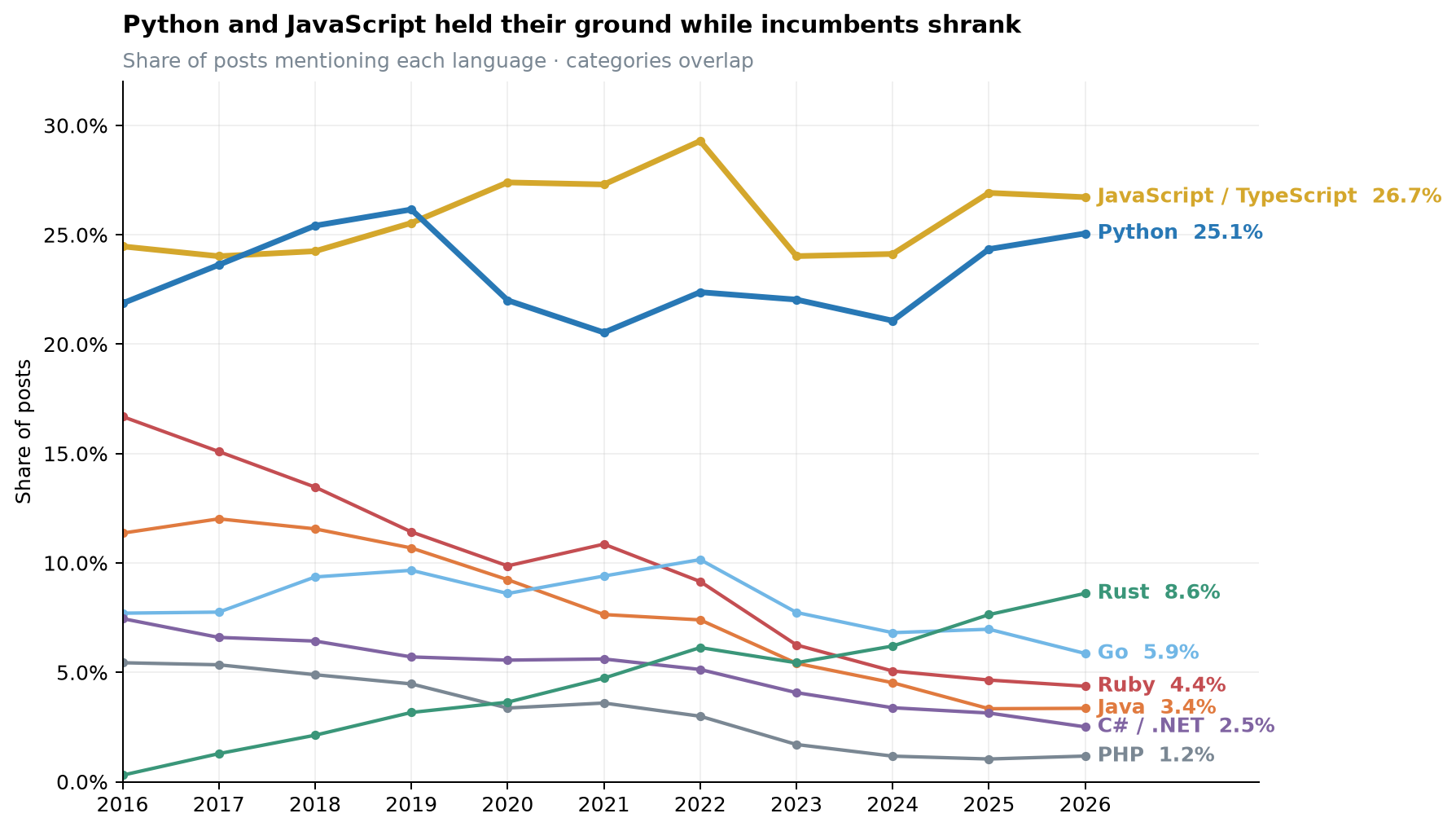
Look at what happened between 2016 and 2026:
| Language | 2016 | 2026 |
|---|---|---|
| JavaScript / TypeScript | 24.5% | 26.7% |
| Python | 21.9% | 25.1% |
| Ruby | 16.7% | 4.4% |
| Java | 11.4% | 3.4% |
| Go | 7.7% | 5.9% |
| C# / .NET | 7.5% | 2.5% |
| PHP | 5.4% | 1.2% |
| Rust | 0.3% | 8.6% |
Ruby lost three-quarters of its share. Java lost 70%. PHP lost 78%. Go, which many people remember as the language that ate the 2010s, peaked at 10.2% in 2022 and has been sliding since. Rust went from a rounding error to more mentions than Go, Java, Ruby, or C#.
Python and JavaScript did not grow much. They simply refused to shrink while the older incumbents around them did. In a market that lost half its posts, holding your share is the whole game.
Step 3: The role stayed the same, but the label changed
Data and machine learning roles have been remarkably stable: 18% of posts in 2016 and 19% in 2026, never moving far from 20% in between. That is the boring finding.
The non-boring one is what companies now call themselves.
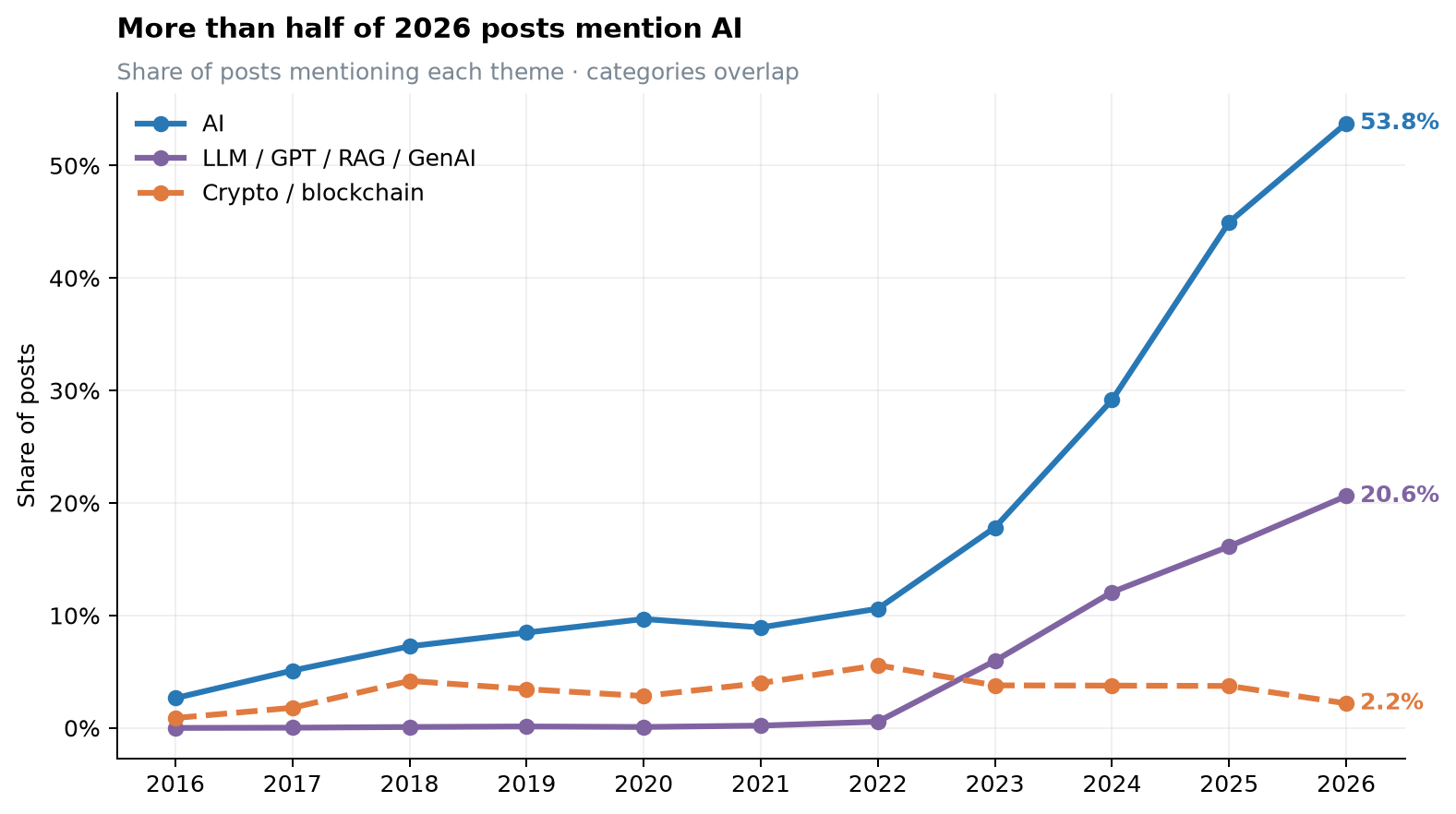
More than half of all job posts in 2026 mention AI. In 2016 it was under 3%. One in five now mentions LLMs, GPT, RAG, GenAI, or a frontier lab by name—a category that did not measurably exist before 2022.
The dotted counterexample is crypto. It peaked at 5.6% of posts in 2022 and is now down to 2.2%. Whatever AI turns out to be, its current share of job posts is more than an order of magnitude larger than crypto's.
Step 4: The only filter that got easier
Here is where the funnel surprised me. Every other requirement became harder to satisfy. Pay disclosure went the other way.
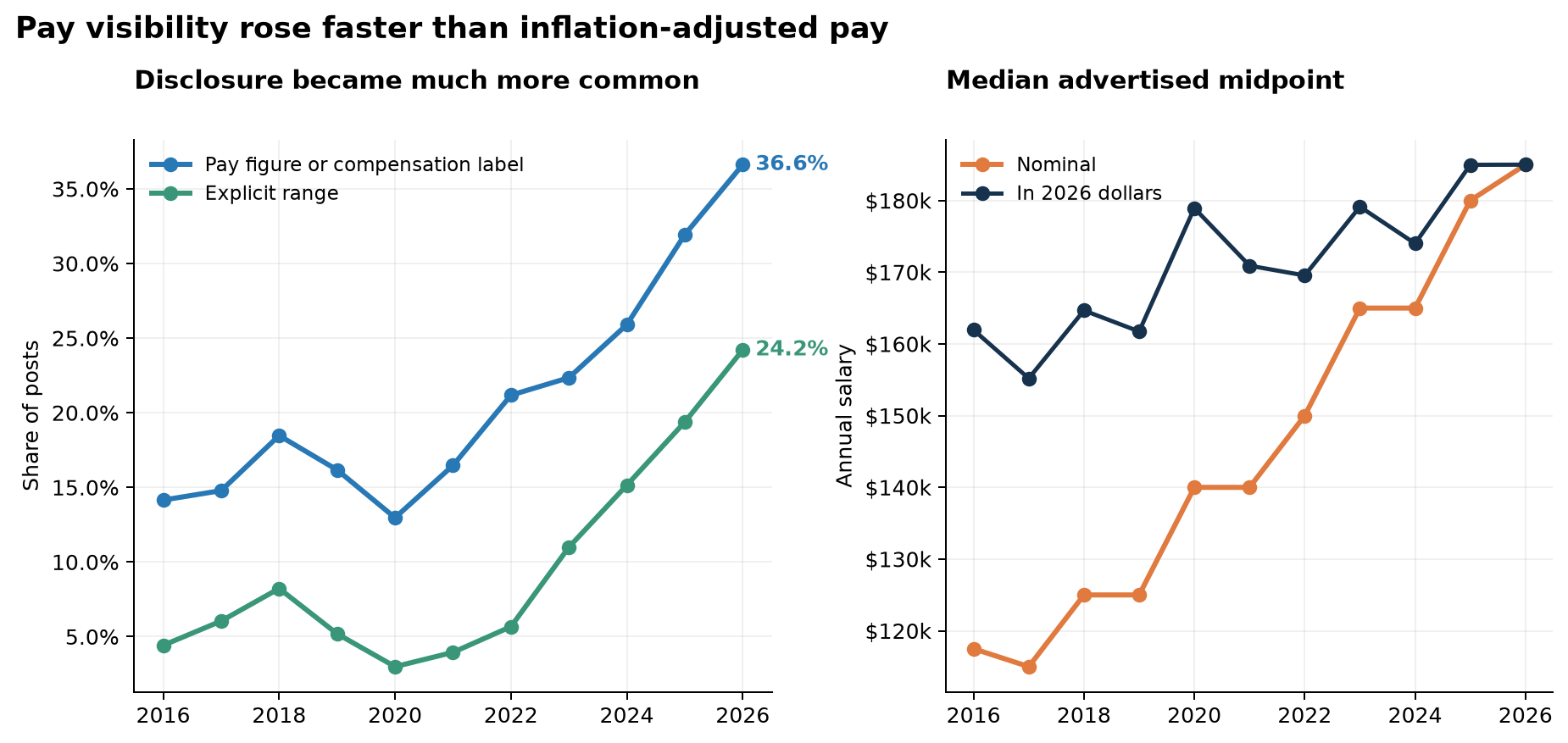
More than a third of all posts now include a pay figure or compensation label, up from 14% in 2016. Explicit ranges—an actual “$X to $Y”—went from 4% to 24%.
The inflection came in 2021–2022. That lines up with Colorado's pay transparency rules, followed by New York City's law, then new requirements in California and Washington State. Companies posting to a US-heavy board started disclosing because a growing share of them had to.
The right panel should temper any celebration. I parsed 4,134 posts with a plausible, machine-readable dollar range. The median advertised midpoint went from $117,500 in 2016 to $185,000 in 2026, up 57%. Expressed in 2026 dollars using US CPI, that becomes about $162,000 to $185,000: a real gain of roughly 14% over a decade, or about 1.3% a year.
There is selection bias baked in. Companies willing to publish a number in 2016 were not the same population as those publishing one today. The 2025 and 2026 CPI values are also assumptions in the notebook because final annual averages are not yet available. The direction is clear enough: advertised pay went up a lot on paper and a little in real terms.
A related detail: 32% of posts that disclose compensation also mention equity, compared with 6.8% of posts that do not. The rise in “equity” mentions since 2023 is mostly the same phenomenon. Once you write a compensation line, you tend to write the whole compensation line.
The bonus finding nobody asked for
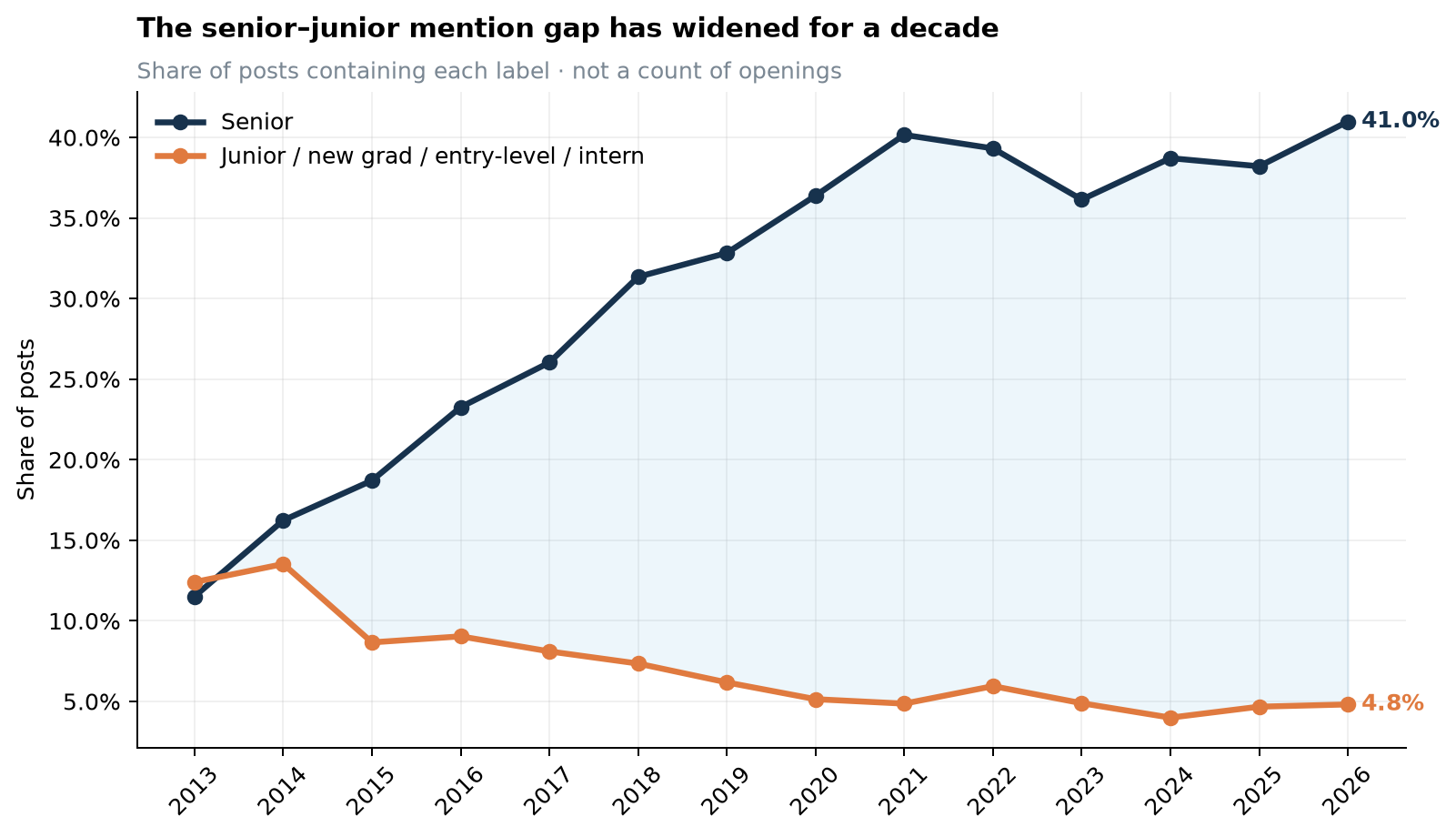
In 2013, “senior” and “junior / new grad / entry-level / intern” appeared in roughly the same share of posts: 11.5% and 12.4%. Today it is 41.0% and 4.8%.
Junior mentions did not collapse recently. They fell sharply between 2014 and 2015 and have drifted down ever since, long before the current downturn and long before AI. The senior line, meanwhile, more than tripled. That gap is the most durable trend in the dataset.
Put the two together
Fewer jobs and a narrower funnel do not necessarily add up to a worse search.
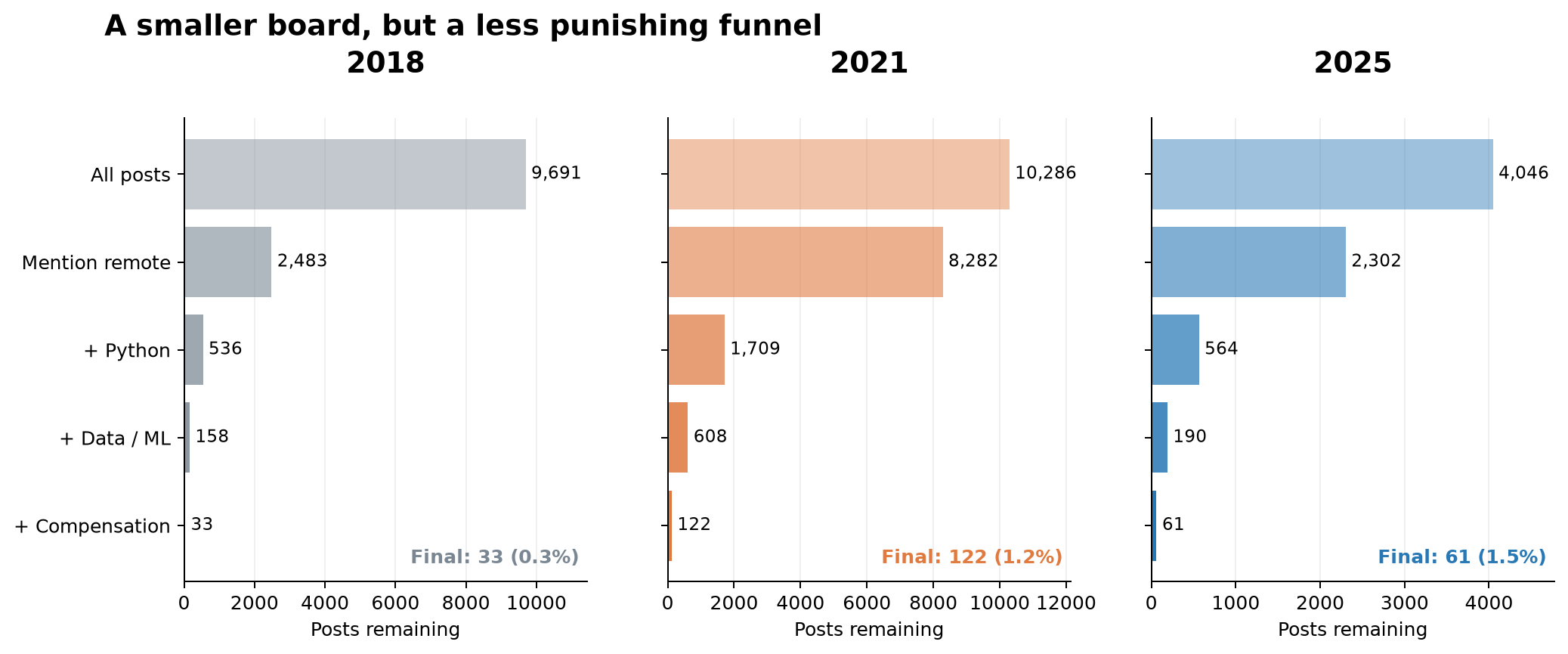
In 2018, 33 posts out of 9,691 cleared all four filters: 0.3%. In 2025, 61 out of 4,046 did: 1.5%. The board is less than half the size it was, yet almost twice as many posts match a remote Python data role with a recognizable compensation signal.
That is the honest summary of the last decade of this thread: fewer employers, but those still posting are much more likely to say where you can work, what you will build, and what they will pay.
What this does not tell you
Keyword matching is a blunt instrument, and I want to be direct about the limits:
- One comment is treated as one entry, but a single comment can advertise five roles.
- A mention is not a requirement. “We use Postgres, not MySQL” still counts as a MySQL mention.
- “Remote” includes geographically restricted remote work. Roughly 1 in 100 remote mentions is a negation such as “no remote”—small, but not zero.
- Pay figures are dollar-denominated and heavily US-weighted, so the salary chart is really a US salary chart.
- Hacker News is a specific, self-selecting slice of the industry: startups, infrastructure companies, and many YC companies. Do not read it as the whole labor market.
- The 2026 data covers January through August only.
Every number in this article comes from transparent patterns in the notebook. If you disagree with how I defined “data role” or “junior,” change the regular expression and rerun it. That is the point of publishing the code.
Run it yourself
Two interactive Mercury apps drive this analysis:
- Remote Tech Job Funnel lets you pick a year, work arrangement, language, and role family, then watch the funnel narrow. Every matching post links to its original Hacker News comment.
- Programming Language Sankey lets you compare the language mix across any set of years.
You can find both apps and the analysis notebook in the Mercury examples repository. To run them locally:
pip install -r who-is-hiring/requirements.txt
mercury --working-dir who-is-hiring
The dataset contains 88,975 comments split into one compressed CSV per year, about 36 MiB in total. The repository includes the analysis notebook that produced every chart in this article, so you can inspect the patterns, change a definition, and rebuild the results yourself.
About the Author

Piotr Płoński
Piotr Płoński is a software engineer and data scientist with a PhD in computer science. He has experience in both academia—working on neutrino experiments at leading research labs and collaborating on interdisciplinary projects—and in industry, supporting major clients at Netezza, IBM, and iQor. In 2016, he founded MLJAR to make data science easier and more accessible, creating tools like AutoML, Mercury, and MLJAR Studio.
Related Articles
- 10 ways to make predictions with Machine Learning model
- Build a Web App for your Machine Learning model
- How to Run a Local LLM in 2026
- XGBoost Vector Leaf: Multi-Output Regression Explained
- GitHub Outages, Day by Day: A GitHub-Style Activity Calendar
- 3 New Mercury Widgets for Interactive Python Data Apps
- I Analyzed 4.5 Years of GitHub Incidents. Here Is What Changed.
- Are iPhones Really More Expensive? An Inflation-Adjusted Dashboard in Python
- How to Use Jev in Python: Choice, Noul, Score + OpenAI Comparison
- What Is an AI Agent Harness? Definition, Diagrams & Open-Source Examples
Private AI data analysis
AI Data Analyst on Your Computer
Use MLJAR Studio to explore data, discover insights, and create reports with AI.
Runs locally · Your data stays private