
What Is an AI Agent Harness?
A large language model on its own can only do one thing: take text in and give text out. It can't run code, read your files, remember yesterday's session, or check whether its answer is correct.
An AI agent harness is the software that gives it those abilities. It wraps the model, calls it in a loop, runs the tools it asks for, feeds the results back, and decides when the work is done.
A simple way to remember it:
Agent = Model + Harness
When you use Claude Code, Codex CLI, OpenCode or any other AI coding assistant, you're not talking to the raw model. You're talking to a harness that manages the model for you.
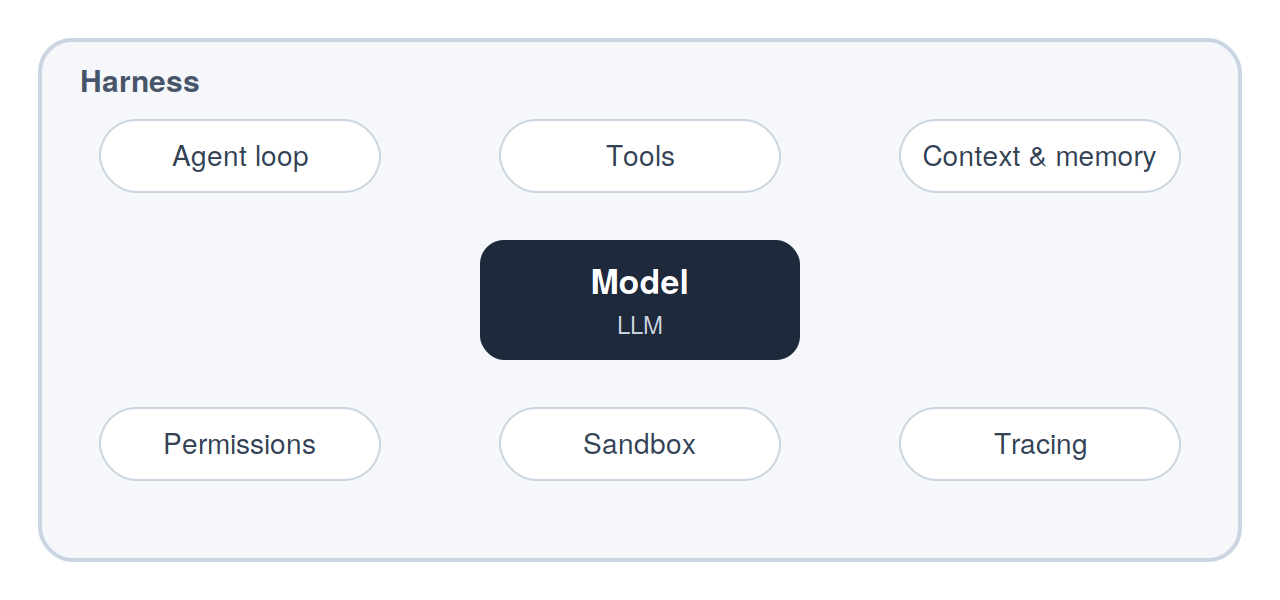
The model sits in the middle. Everything around it is the harness.
Why is it called a "harness"?
A harness is the gear that connects a horse to a cart and steers it. The horse provides the power; the harness points that power in a useful direction. An LLM works the same way: the model provides the intelligence, and the harness provides the structure.
How an agent harness works: the agent loop
At the core of every harness is a simple loop:
- Send the task and the context to the model.
- The model either answers or asks to use a tool, for example "run this Python code".
- The harness runs the tool and captures the result.
- The result goes back to the model.
- Repeat until the model is done, or until a limit is hit.
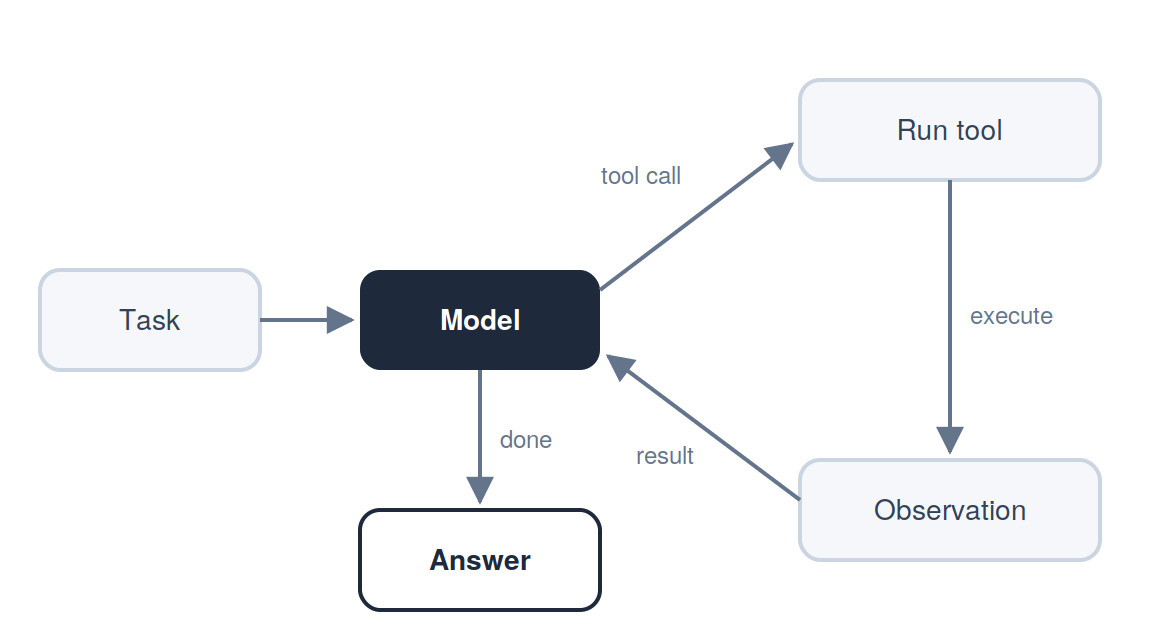
The agent loop: the model calls tools until the task is done.
Here's what a minimal harness looks like in Python. It's about 20 lines:
import subprocess

def run_agent(model, task, max_steps=20):
    messages = [
        {"role": "system", "content": "Solve the task. Reply with one bash command, or DONE: <answer>."},
        {"role": "user", "content": task},
    ]
    for _ in range(max_steps):
        reply = model(messages)                      # 1. call the model
        messages.append({"role": "assistant", "content": reply})
        if reply.startswith("DONE:"):                # 2. stop condition
            return reply[5:].strip()
        result = subprocess.run(                     # 3. run the tool
            reply, shell=True, capture_output=True, text=True, timeout=60
        )
        output = (result.stdout + result.stderr)[-5000:]  # 4. truncate
        messages.append({"role": "user", "content": output})  # 5. feed back
    return "Step limit reached."
This isn't a toy. The open-source mini-SWE-agent uses roughly this design, about 100 lines with bash as its only tool, and scores above 74% on the SWE-bench Verified coding benchmark.
What's inside a production harness?
Real harnesses add a lot around the basic loop:
| Component | What it does |
|---|---|
| Agent loop | Calls the model, parses tool calls, repeats until done |
| Tools | Shell, file editing, code execution, web search, MCP servers |
| Context management | Summarizes or trims old messages when the context window fills up |
| Memory | Notes, progress files and skills that survive between sessions |
| Instructions | System prompt plus project files like AGENTS.md or CLAUDE.md |
| Permissions & sandbox | Decides what the agent can run without asking; isolates execution |
| Planning | To-do lists the model updates as it works |
| Sub-agents | Hands a subtask to a fresh agent and gets back a short summary |
| Error handling | Retries bad output, detects loops, verifies "I'm done" claims |
| Tracing | Logs every step so you can debug and improve the agent |
Why the harness matters as much as the model
It's tempting to think only the model matters. The benchmarks say otherwise.
LangChain improved its coding agent on Terminal-Bench 2.0 from 52.8% to 66.5%, moving from the top 30 to the top 5, without changing the model. They only changed the harness: they forced a build-and-verify step, gave the agent better context at startup, and added detection for doom loops.
The same pattern shows up on public leaderboards: one model scores differently depending on which harness runs it. This is why "harness engineering" became a discipline of its own in 2026, and why model labs like DeepSeek now release their own harnesses next to their models.
In practice, two products using the same model can feel completely different. The harness is where that difference comes from.
Two meanings of "harness"
You'll see the word used in two ways:
- Runtime (agent) harness: runs the agent. This is what this article is about.
- Evaluation harness: a fixed test rig that runs a model or agent on benchmark tasks and scores it. Examples are lm-evaluation-harness, Inspect AI and Harbor.
The difference is simple: you change a runtime harness to get better results, and you keep an evaluation harness fixed so results stay comparable.
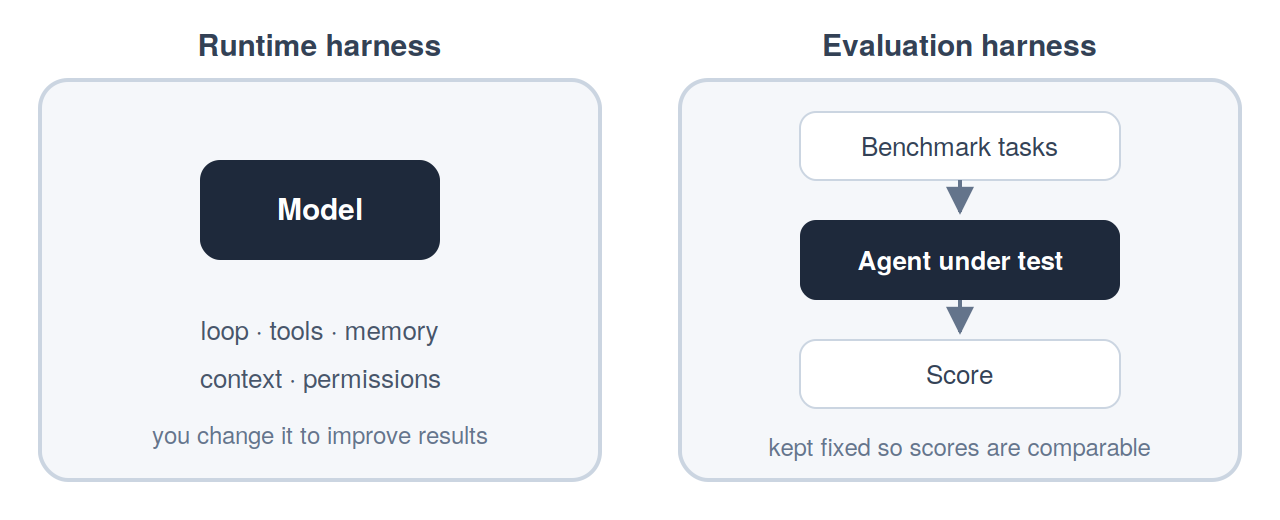
Harness vs. framework vs. model
- Model: the LLM weights. Pure reasoning, no actions.
- Framework / SDK: building blocks for making a harness (LangGraph, Pydantic AI, OpenAI Agents SDK).
- Harness: the assembled, tuned system that actually runs the agent (Codex CLI, OpenCode, Hermes Agent).
The lines blur. LangChain, for example, describes its Deep Agents as an "opinionated harness" built on its LangGraph framework.
Open-source AI agent harnesses (2026)
Below are the most useful open-source harnesses, grouped by what they're for. Licenses and project status change quickly, so check each repository before you build on it.
Coding agent harnesses
| Harness | License | Models | Why it's interesting |
|---|---|---|---|
| OpenAI Codex CLI | Apache-2.0 | OpenAI-first, configurable | Rust; strong sandboxing; well-documented agent loop |
| OpenCode | MIT | 75+ providers | Terminal, desktop and IDE; very model-agnostic |
| Aider | Apache-2.0 | Any, incl. local | Git-native pair programmer |
| Cline | Apache-2.0 | Any, BYOK | Popular VS Code agent |
| OpenHands | MIT | Any (LiteLLM) | Docker sandbox; also an SDK |
| Gemini CLI | Apache-2.0 | Gemini | Google's terminal agent |
| Oh My Pi | MIT | 60+ providers | Pi fork with LSP, debugger, sub-agents |
| DeepSeek Harness (dsh) | MIT | DeepSeek + other providers | Official DeepSeek harness; "everything is a plugin"; developer preview |
Note: Claude Code is not open source. Its GitHub repository contains docs and issues, not the source.
General-purpose and personal agent harnesses
| Harness | License | Why it's interesting |
|---|---|---|
| Hermes Agent (Nous Research) | MIT | Runs on your server, keeps long-term memory, creates its own skills |
| goose | Apache-2.0 | Desktop app, CLI and API; part of the Linux Foundation's Agentic AI Foundation |
| Deep Agents (LangChain) | MIT | Planning, filesystem and sub-agents built in |
Minimal and educational harnesses
| Harness | License | Why it's interesting |
|---|---|---|
| mini-SWE-agent | MIT | About 100 lines; the best code to read first |
| smolagents | Apache-2.0 | The agent writes Python code as its actions |
Agent SDKs (for building your own harness)
| SDK | License | Notes |
|---|---|---|
| OpenAI Agents SDK | MIT | Native Responses API; other models via LiteLLM |
| Pydantic AI | MIT | Typed, model-agnostic |
| Microsoft Agent Framework | MIT | Successor to AutoGen and Semantic Kernel |
Harnesses for Jupyter notebooks and data analysis
| Project | License | Notes |
|---|---|---|
| Jupyter AI | BSD-3 | Runs external agents inside JupyterLab |
| jupyter-mcp-server | BSD-3 | Lets any MCP agent edit and run live notebooks |
Evaluation harnesses
| Harness | License | Notes |
|---|---|---|
| Inspect AI | MIT | Agent evals from the UK AI Security Institute |
| Harbor | Apache-2.0 | Official Terminal-Bench harness |
| lm-evaluation-harness | MIT | Classic benchmark runner for LLMs |
Why harnesses matter for data analysis
Coding harnesses mostly run shell commands that forget everything between steps. Data analysis needs something different: a stateful Python kernel, where a DataFrame loaded in step 1 is still in memory in step 10.
That's why a Jupyter notebook is a natural execution environment for a data agent. Every step is a cell, every result is visible, and you can review and rerun what the agent did.
Try MLJAR Studio, a local AI data analyst that turns questions in plain English into Python code, charts, and reproducible notebooks. Use it to explore datasets and run machine learning experiments, with code and results you can inspect, edit, and rerun.
FAQ
What is an AI agent harness in simple terms? It's the software around an LLM that lets it act: it calls the model in a loop, runs tools, manages memory and context, and decides when to stop.
Is an agent harness the same as an agent framework? Not quite. A framework gives you building blocks; a harness is a finished, tuned system built from them.
Is Claude Code open source? No. OpenAI Codex CLI, OpenCode, Aider, Cline and OpenHands are open-source alternatives.
What is the simplest open-source agent harness? mini-SWE-agent. It's about 100 lines of Python with a single bash tool.
Does the harness affect benchmark scores? Yes. LangChain gained almost 14 points on Terminal-Bench 2.0 by changing only its harness.
What is harness engineering? The practice of designing and tuning the harness (tools, context, verification, limits) to get better results from the same model.
About the Author

Piotr Płoński
Piotr Płoński is a software engineer and data scientist with a PhD in computer science. He has experience in both academia—working on neutrino experiments at leading research labs and collaborating on interdisciplinary projects—and in industry, supporting major clients at Netezza, IBM, and iQor. In 2016, he founded MLJAR to make data science easier and more accessible, creating tools like AutoML, Mercury, and MLJAR Studio.
Related Articles
- 10 ways to make predictions with Machine Learning model
- Build a Web App for your Machine Learning model
- How to Run a Local LLM in 2026
- XGBoost Vector Leaf: Multi-Output Regression Explained
- GitHub Outages, Day by Day: A GitHub-Style Activity Calendar
- 3 New Mercury Widgets for Interactive Python Data Apps
- I Analyzed 4.5 Years of GitHub Incidents. Here Is What Changed.
- How Hard Is It to Find a Remote Python Data Job? I Checked 88,975 Hacker News Job Posts
- Are iPhones Really More Expensive? An Inflation-Adjusted Dashboard in Python
- How to Use Jev in Python: Choice, Noul, Score + OpenAI Comparison
Private AI data analysis
AI Data Analyst on Your Computer
Use MLJAR Studio to explore data, discover insights, and create reports with AI.
Runs locally · Your data stays private