
Part 1 — Introduction · 15 min read
Machine Learning in Plain English
Learn what machine learning is, how computers find patterns in data, and why human knowledge still matters.
Look at the carpet below.

Most of the carpet is visible, but one part has been covered by a gray area. What do you think is hidden underneath it?
You probably expect the missing part to continue the pattern that you can already see. The same colors should appear again. The shapes should repeat in the correct places. The spacing and symmetry should match the rest of the design. You may not know the exact rules used by the person who created the carpet, but your brain still forms an idea of what the hidden part should look like.
Now look at the complete carpet.

Perhaps your prediction was not perfect, but it was probably close. You were able to imagine the missing section because you recognized a pattern in the visible part of the carpet. You noticed repetition, relationships between shapes, and the order in which the colors appeared. Based on what you could already see, you predicted something that was hidden.
This simple example introduces the main idea behind machine learning. Humans are naturally good at detecting patterns. Machine learning is an attempt to help computers do something similar: learn from examples, discover useful relationships, and use what they have learned to make predictions.
Humans Look for Patterns Everywhere
Pattern recognition is not a special skill that we use only when solving puzzles. We use it constantly, often without noticing that we are doing it. We recognize familiar faces even when the lighting changes or a person is wearing different clothes. We read handwriting even though every letter looks slightly different. We hear that a machine sounds unusual and suspect that something may be wrong. We see dark clouds and expect rain.
In each of these situations, our brains compare the present situation with things we have experienced before. We have seen faces, letters, clouds, machines, and human behavior many times. Over time, we have learned what is normal, what is unusual, and what often happens next.
We usually do not need to describe the exact rule behind what we recognize. You can identify a dog in a photograph, but writing a perfect list of rules that describes every possible dog would be extremely difficult. Dogs can be large or small, dark or light, sitting or running, close to the camera or far away. Despite these differences, most people can still recognize one immediately.

Humans are especially good at this kind of flexible recognition. We can often understand a situation from a small number of examples and from our broader knowledge of the world. Computers do not naturally have this ability. They need data and a systematic way to learn from it.
That is where machine learning becomes useful.
What Is Machine Learning?
Machine learning is a way of helping computers find patterns in data and use those patterns to make predictions.
The carpet provides a simple analogy. You observed the visible part of the design and tried to predict the missing section. In machine learning, a computer studies known examples and searches for patterns that may help it predict something unknown.
Imagine that we have information about houses that were sold in the past. For each house, we may know its size, location, number of rooms, age, condition, and final selling price. By studying many such examples, a computer can search for relationships between the characteristics of a house and its price.
When we later provide information about another house, the computer can use the relationships found in the historical data to estimate how much that house may be worth. It does not need to have seen that exact house before. It uses what it learned from earlier examples to make a prediction about a new one.
This is different from writing every possible rule by hand. A traditional computer program follows rules created by a programmer. For example, a programmer might write that a house should receive a certain price increase when it has an additional bedroom, another increase when it is close to the city center, and a reduction when it is old. However, the real relationship between all these details may be too complicated to describe with a small set of fixed rules.
With machine learning, we provide examples and let the computer search for useful relationships within them. We still need to decide what problem we want to solve and what data should be used, but we do not need to manually describe every possible situation.
The central idea is simple: we use information from the past to help us make predictions about new situations.
Some Patterns Are Easy to See
Many patterns can be recognized without advanced technology. Larger houses often cost more than smaller houses in the same area. Customers who purchase regularly may be more likely to buy again. A machine that becomes unusually hot may be developing a fault.
Domain experts already know many patterns like these. A doctor understands relationships between symptoms and diseases. An engineer knows how a healthy machine should behave. A marketer recognizes loyal customers from those losing interest.
This knowledge is essential. Machine learning does not remove the need for experience or professional judgment. People with strong domain knowledge are often best placed to find useful applications for it, because they know which questions matter and which results are realistic.
Sometimes a relationship is easy to see in a table or a chart. In other cases, the pattern is hidden among many measurements and cannot be noticed so easily.
Some Patterns Are Difficult to See
Consider a doctor who wants to estimate the risk that a patient will develop a cardiovascular disease. The available information may include the patient’s age, weight, blood pressure, cholesterol level, medical history, laboratory results, medications, physical activity, diet, and smoking habits.
Some relationships are well known. Smoking, for example, is associated with a higher risk of cardiovascular disease. However, the complete picture is usually more complicated. A particular measurement may be important only for older patients. Another may matter more when combined with a specific medical condition. Several small effects may become meaningful only when considered together.
A human expert can understand many relationships, but there is a limit to how many values can be compared at once. When hundreds or thousands of previous cases are available, it becomes difficult to inspect them manually and recognize every important combination.
A computer can examine large numbers of examples and compare many measurements at the same time. It can search for subtle relationships that may be difficult to notice by looking at individual rows, charts, or summary statistics.
Why Computers Are Helpful
Humans are excellent at understanding context, using experience, and making sense of unfamiliar situations. Computers have different strengths. They can examine millions of rows, compare many values at once, and repeat the same calculations consistently. They can test a large number of possible relationships and work with datasets that would take a person many years to inspect manually.
These abilities make computers powerful tools for pattern recognition. However, their strengths should not be confused with human understanding. A computer may discover that two values are related without knowing why. It may find a relationship that is accidental or caused by something that is missing from the data. It may also learn from mistakes, unfair decisions, or outdated practices recorded in historical datasets.
The computer is good at processing information. The human is still needed to understand the problem, evaluate the results, and decide whether the discovered pattern is meaningful.
This cooperation between human knowledge and computer calculation is one of the most important ideas in practical machine learning. We do not need to choose between people and machines. The best results often come from combining the strengths of both.
Machine Learning Is Not Magic
Machine learning can sometimes look like magic. We provide a table of data, the computer performs many calculations, and a prediction appears. However, there is no magic inside the process.
Machine learning combines ideas from mathematics and computer science. You do not need to understand all the mathematics before you begin using machine learning. Many people drive cars without knowing how every part of the engine works. They still need to understand how to control the car, what the warning lights mean, and when it may be unsafe to continue driving.
We will take a similar approach in this book. The goal is not to hide the technical ideas, but to introduce them gradually, when they become useful. You will first learn how to recognize suitable problems, prepare data, run experiments, and understand the results well enough to know when to trust them.
AutoML will help us with many technical steps, but it will not remove the need to understand what we are doing. A tool becomes most useful when we know both what it can do and where its limitations begin.
Three Main Ways Machines Learn
Machine learning is usually divided into three broad categories: supervised learning, unsupervised learning, and reinforcement learning. Each category answers a different kind of question — whether we already know the outcome we want to predict, whether we are only looking for structure in the data, or whether we are learning through trial and error.
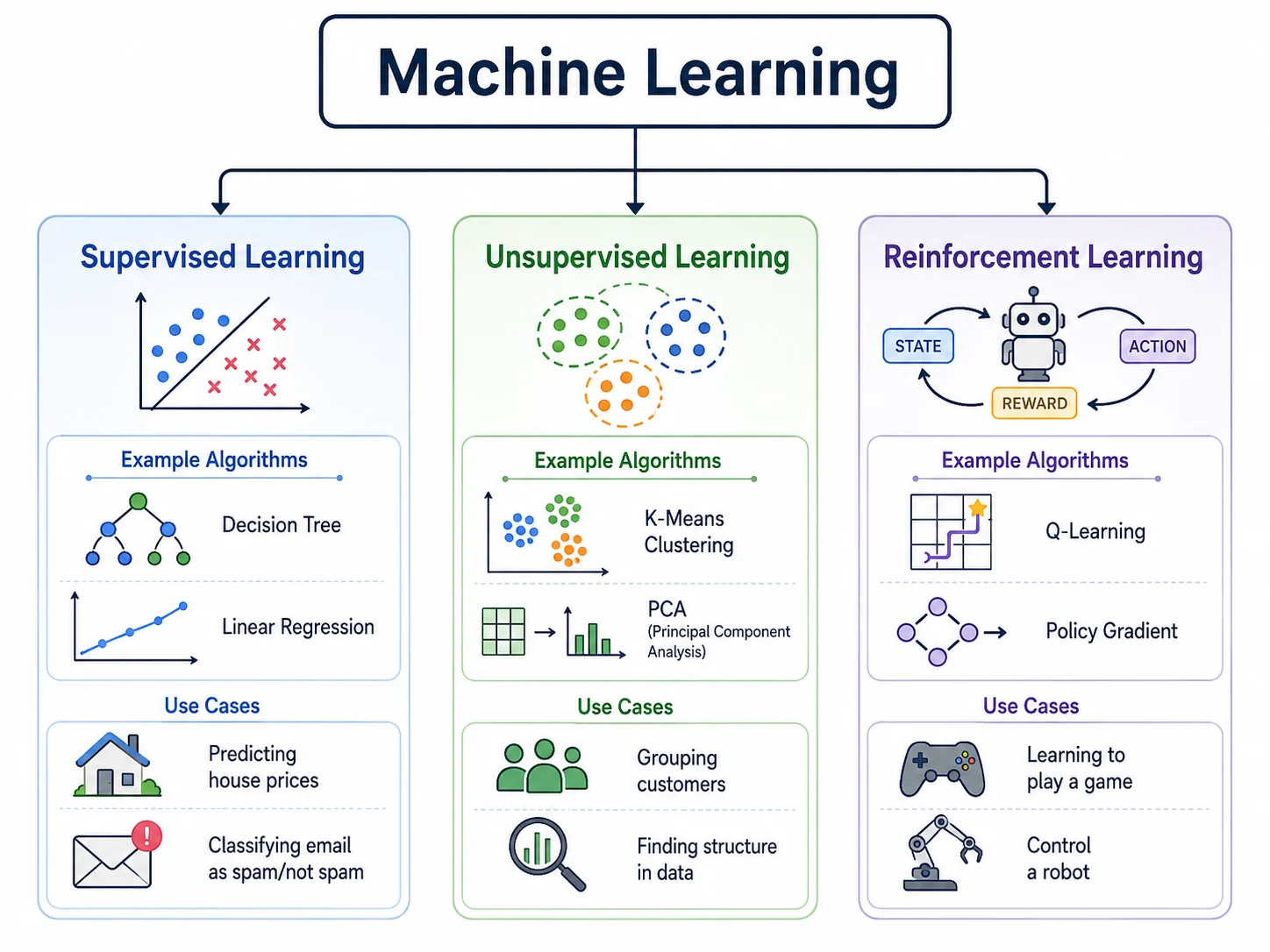
This book will focus mainly on supervised learning because it is widely used with tabular data, spreadsheets, CSV files, and datasets collected in business and research. However, it is useful to understand how supervised learning fits into the broader field.
Supervised Learning
In supervised learning, the computer learns from examples for which the correct result is already known.
Consider employee attrition. A company may have records of past employees — their role, tenure, salary, performance reviews, and workload — along with whether each one eventually left the company or stayed. The computer studies these past cases and searches for relationships between an employee's information and the outcome.
When we later look at a current employee, the computer can use the relationships found in past cases to estimate how likely that person is to leave. It does not need to have seen that exact employee before. It uses what it learned from earlier cases to make a prediction about a new one.
Supervised learning can be used for many practical tasks beyond attrition. It may help estimate insurance costs, recognize whether an email is spam, or predict which customers are likely to stop using a product.
In all these cases, the computer learns from examples where the result is known. It then uses what it has learned to make predictions for new cases.
Most of the projects in this book will follow this approach. We will work with historical data, ask a clear prediction question, and use AutoML to search for patterns that may help answer it.
Unsupervised Learning
In unsupervised learning, the computer receives data without being told what the correct result should be. Instead of learning to predict a known answer, it searches for structure in the data.
Imagine that a company has information about thousands of customers but does not know how those customers should be divided into meaningful groups. An unsupervised learning method can search for customers who behave in similar ways.
It may discover one group of frequent customers, another group that buys mainly during promotions, and a third group that has recently become less active. These groups were not provided in advance. They were discovered by examining similarities in the data.
Unsupervised learning can also be used to find unusual observations, simplify complex datasets, explore relationships, or identify natural groups. It is often useful when we want to understand the structure of a dataset before deciding what should be predicted.
This book will mention unsupervised learning where it is helpful, but it will not be our main focus.
Reinforcement Learning
In reinforcement learning, a computer learns by taking actions and receiving rewards or penalties. Instead of studying a fixed collection of examples, it interacts with an environment and gradually learns which actions lead to better outcomes.
A computer learning to play a game is a common example. At first, it may make poor decisions. Some actions cause it to lose points, while others improve its position. By trying many actions and observing their consequences, it can gradually develop a better strategy.
Reinforcement learning can also be used for controlling robots, managing complex systems, and learning sequences of decisions. It is especially useful when the result depends on a series of actions rather than a single prediction.
Although reinforcement learning is an important and fascinating area, it is quite different from the type of practical tabular machine learning covered in this book. Our examples will concentrate mainly on supervised learning.
Machine Learning Does Not Think Like a Human
The word learning can be misleading because it suggests that a computer learns in the same way as a person. It does not.
A machine learning system does not necessarily understand what a house, customer, disease, or financial market is. It works with information represented as numbers, categories, text, images, or other forms of data. It searches for relationships and uses them to calculate an output.
This distinction matters because finding a relationship is not the same as understanding it. A computer may discover that two things often appear together without knowing why. It may find that patients with a particular measurement often face a higher risk, but it does not understand the biological reason behind the relationship unless that knowledge is somehow represented in the data.
It may also find misleading relationships. Suppose a system notices that a certain type of customer is more likely to cancel a subscription. The relationship may be real, but it may be caused by another factor that was not recorded. Perhaps those customers received worse service, lived in an area with poor delivery, or were offered a different price.
The system can calculate a prediction without understanding the wider story. This is why domain experts remain essential. They can ask whether the relationship makes sense, whether important information is missing, and whether the result should be trusted.
A prediction is useful information, but it is not the same as human understanding.
Patterns Can Change
Another challenge is that the world does not stay the same. Customer behavior changes, markets react to new events, machines become older, medical practices improve, and companies update their products and processes. Laws, prices, technologies, and social habits also change over time. A pattern that was useful several years ago may no longer describe what is happening today.
Imagine that a company creates a machine learning system using customer data collected five years ago. Since then, the company may have changed its prices, redesigned its website, introduced new products, or started serving a different group of customers. Even if the system worked well when it was created, its predictions may gradually become less accurate because the conditions around it have changed.
For this reason, a machine learning system should not be trained once and trusted forever. Its predictions should be checked using new data. When its performance begins to decline, it may need to be updated, retrained, or replaced.
Machine learning is therefore not only about finding a pattern. It is also about checking whether that pattern remains useful as the world changes.
Data Can Contain Human Mistakes
Machine learning learns from data, and data is rarely perfect. It may contain missing information, incorrect values, duplicated records, or measurements collected in inconsistent ways. Historical data may also reflect poor decisions, unequal treatment, or outdated practices.
If a computer learns from biased or incomplete data, it can reproduce that bias in its predictions. For example, suppose a company creates a system to help select job candidates using data from previous hiring decisions. If the earlier process favored certain groups, the new system may learn to repeat that preference. The computer does not know whether the historical decisions were fair. It only sees patterns in the examples it receives.
This is why the quality of the data matters so much. We need to ask where the data came from, how it was collected, what may be missing, and whether the historical results are suitable for learning.
AutoML can automate many calculations, but it cannot decide whether the data represents the problem fairly and responsibly. That remains a human task.
People Are Still Responsible
Machine learning can support decisions, but it should not remove human responsibility. A prediction may be useful evidence, but it should not always become the final decision. A hiring manager may use a prediction as one signal among many, alongside interviews and references. A bank may use a system to flag transactions for further investigation, rather than automatically accusing someone of fraud.
The role of machine learning is often to help people notice patterns and prioritize cases, not to replace judgment. A person must still decide whether a prediction is meaningful, responsible, and useful.
Machine Learning as a Practical Tool
Machine learning is not only for large technology companies or specialist teams. It's useful anywhere people collect data and need to make repeated decisions — an HR specialist investigating attrition, a marketer predicting customer responses, a business owner estimating demand.
The starting point is usually a practical question, not a formula: Can we estimate a cost? Predict which customers may leave? Identify unusual cases? Machine learning helps us explore whether the data contains an answer.
Sometimes it will. Sometimes a simple rule or chart will do the job just as well. Knowing when to reach for machine learning — and when not to — is part of using it responsibly.
Chapter Summary
Humans are very good at finding patterns. We do this every day, often without thinking about it. Machine learning helps computers find patterns in data. Instead of writing every rule by hand, we give the computer examples and let it learn from them.
Computers can work with large amounts of data and compare many values at the same time. But they do not understand the world like humans do. People are still needed to choose the right problem, check the results, and decide how predictions should be used.
This book will focus mainly on supervised learning with tables, spreadsheets, and CSV files.
In the next chapter, we will see why building a good machine learning model takes many experiments, and how AutoML can make this work easier.
Would you like to follow the book as it grows?
Subscribe through a short Google Form and we'll let you know when a new chapter is ready.