
MLJAR Studio vs Deepnote

When choosing an AI tool for data analysis, MLJAR Studio and Deepnote support very different workflows.

Deepnote is primarily a cloud-based collaborative notebook platform built for team-based data analysis, SQL and Python workflows, integrations with modern data stacks, and sharing results inside a shared workspace. This guide compares the two tools across privacy, notebook workflows, machine learning capabilities, and flexibility so you can decide which one fits your work better.

Fast Answer

Best for: MLJAR Studio vs Deepnote

Use this quick summary before reading the detailed feature tables and workflow notes.

QuestionMLJAR StudioDeepnote
Best for MLJAR Studioyou work with sensitive datasets and want a local-first defaultChoose Deepnote if you need real-time collaboration in shared cloud notebooks.
Best for DeepnoteChoose MLJAR Studio when you need local control, visible Python code, and a reproducible notebook artifact.you work directly against warehouses, databases, and a broader cloud data stack
Migration difficultyLow if your current work can be exported to Python, CSV, or .ipynb; review package dependencies and data paths.Usually easiest to keep using Deepnote when your team already depends on its collaboration, hosting, or platform workflow.

TL;DR

Quick verdict

Choose MLJAR Studio if...

You need a real data science environment

You want a local-first notebook workflow where data and code stay on your machine by default. You need transparent AI-assisted analysis saved into portable Python notebooks. You want built-in AutoML and repeatable machine learning experimentation. You want to turn notebooks into web apps through Mercury without rebuilding the project from scratch.
Choose Deepnote if...

You prefer Deepnote for its core workflow

You want cloud-first collaboration, permissions, and sharing inside one workspace. You want strong integrations with databases, warehouses, and team workflows. You want notebook scheduling, APIs, and hosted app sharing in the same platform.

Feature Comparison

Side by side

A practical look at how MLJAR Studio and Deepnote differ across privacy, notebooks, AI assistance, and machine learning work.

FeatureMLJAR StudioDeepnote
Runs locallyYesPrimarily cloud-based
Data stays on your machine by defaultYesNo
Real-time collaborationLimitedStrong
Real Python notebooksYesYes
Built-in AI assistantYesYes
Autonomous ML experiments / AutoMLStrongManual
Feature engineering automationStrongManual
Publish notebooks as web appsYes (Mercury)Yes (apps / Streamlit)
Scheduling / background executionLimitedYes
Pricing modelFree, Pro, or Business hosted plans + $199 perpetual licenseFreemium + per editor

Where MLJAR Leads

What MLJAR Studio does better

MLJAR Studio is strongest when the work needs local execution, transparent Python code, and repeatable notebook-based machine learning.

Private by design

MLJAR Studio runs locally on your computer, so datasets, notebooks, and experiments stay under your control. You can also work with Local LLMs or connect your own AI provider.

Autonomous ML experiments

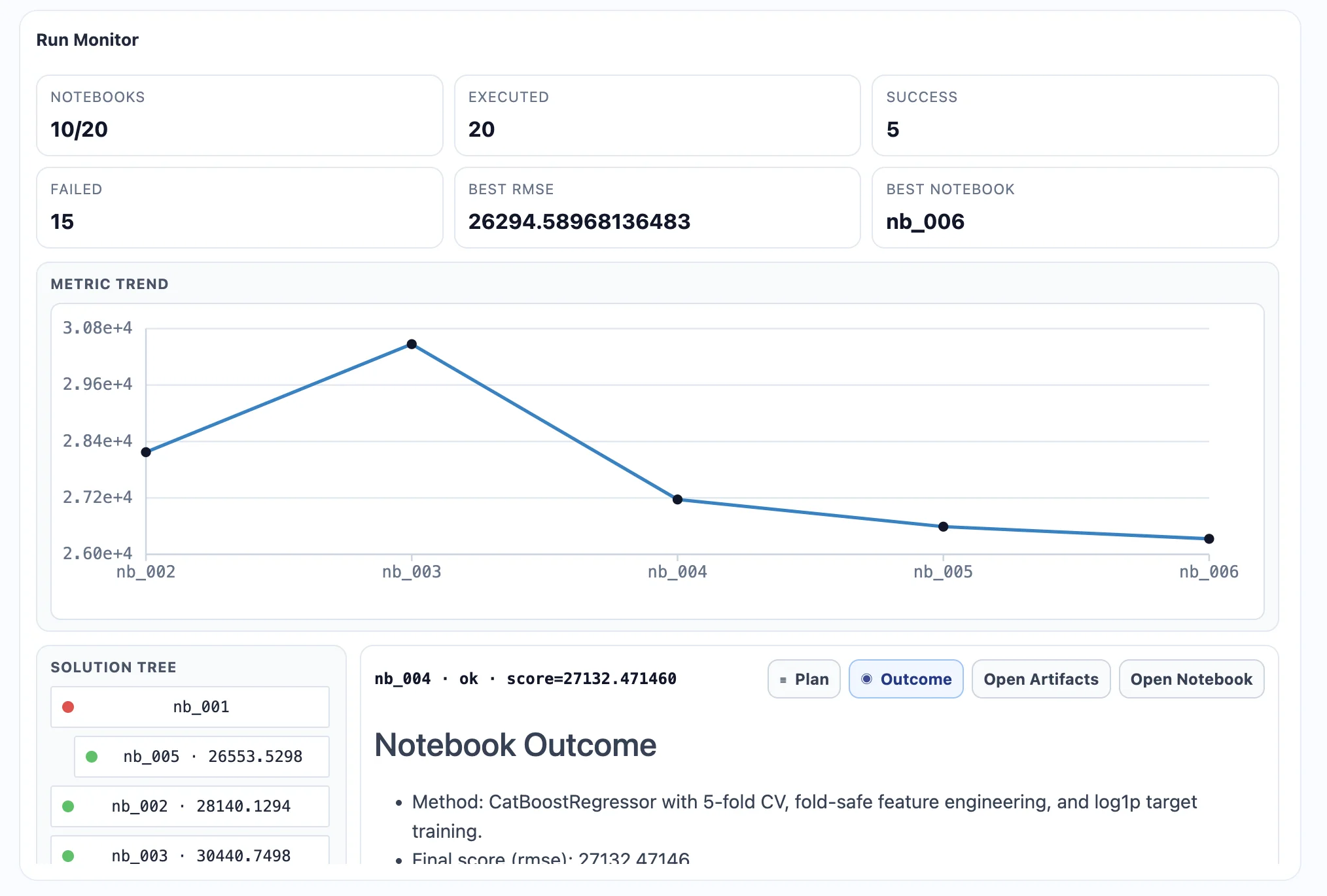
AutoLab can run machine learning experiments autonomously, exploring feature transformations, testing pipelines, and searching for stronger predictive performance.

Real Python environment

MLJAR Studio uses real Python notebooks, so you can work directly with pandas, scikit-learn, visualization libraries, and reproducible notebook workflows.

AI assistance with transparent code

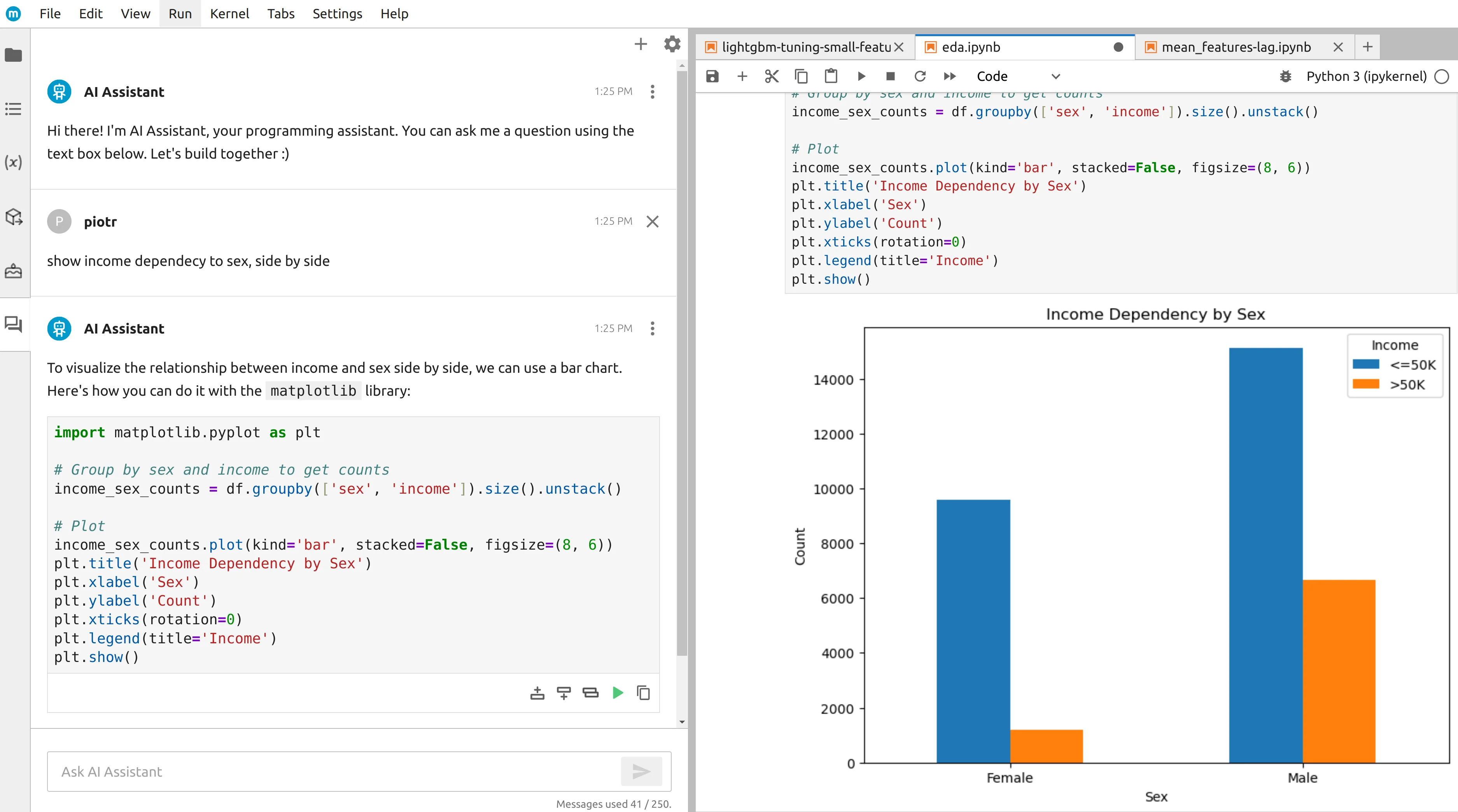
The built-in AI assistant helps with data exploration, code generation, and charting while keeping the generated Python visible, inspectable, and editable.

From notebooks to apps

You can convert notebook-based analysis into interactive web apps with Mercury, which makes sharing tools and dashboards much easier.

Flexible AI setup

Use the hosted Free, Pro, or Business plans in MLJAR Studio, or buy the perpetual license to run Local LLMs and connect your own AI provider keys.

Fair Assessment

What Deepnote does well

There are still good reasons to choose Deepnote, especially when its core workflow matches the job.

Cloud-first collaboration and sharing

Deepnote is built around real-time collaboration, project sharing, commenting, permissions, and workspace organization for teams.

Integrations and automation

Deepnote has strong integrations with databases, warehouses, storage tools, and productivity systems, plus scheduling, notifications, and API-triggered notebook runs.

Apps and workspace publishing

Deepnote supports publishing and hosting app-style outputs, including Streamlit workflows, inside the workspace environment.

AI built into the cloud notebook experience

Deepnote AI and Deepnote Agent are designed to generate, edit, explain, and modify notebook blocks directly inside the shared cloud workflow.

Decision Guide

When to choose each tool

Use this section as a buyer guide: the right tool depends on where the work runs, who reviews it, and how often it must be repeated.

Choose MLJAR Studio when...

  • you work with sensitive datasets and want a local-first default
  • you want portable .ipynb notebooks instead of a cloud workspace as the main source of truth
  • you need AutoML, model benchmarking, and repeatable ML experimentation
  • you want AI-generated code to remain visible and auditable in the notebook
  • you prefer controlling the runtime and Python environment on your own machine
  • you want to turn notebook outputs into Mercury apps
  • you want to use Local LLMs or your own provider keys in a standard Python workflow

Choose Deepnote when...

  • you need real-time collaboration in shared cloud notebooks
  • you work directly against warehouses, databases, and a broader cloud data stack
  • you want scheduling, notifications, and API-triggered notebook execution
  • you want hosted workspace apps and cloud sharing as part of the same product
  • your organization prefers cloud governance, permissions, and managed infrastructure

Detailed Comparison

Workflow differences in practice

A second table helps cover nuances around environment control, experimentation, and reproducibility.

FeatureMLJAR StudioDeepnote
Primary workflowDesktop notebook IDE with AI assistance, local execution, and AutoML-oriented experimentation.Cloud notebook workspace with collaboration, integrations, AI assistance, and team sharing.
Execution environmentLocal runtime on your machine.Primarily cloud runtime, with separate local tooling around .deepnote files.
Privacy modelLocal-first workflow makes it easier to keep datasets on your own machine.Cloud-first workflow with security controls, permissions, and enterprise governance.
AI capabilitiesAI assistant and agent-like flows that generate code into notebooks; built-in assistant uses cloud models.Deepnote AI and Deepnote Agent generate, explain, and edit notebook blocks directly in the workspace.
ML experimentationStronger AutoML, benchmarking, and repeatable experiment positioning.Notebook-based ML workflows are possible, but more manual than AutoML-first tooling.
Reproducibility and transparencyAI-assisted work is saved into portable .ipynb notebooks that can be reviewed and rerun.Notebook workflows remain reproducible, but are more tightly centered around the workspace model.
Sharing resultsCreate AutoML reports, notebook reports, and Mercury interactive reports with browser sharing and HTML/PDF export.Share notebooks, links, embedded content, and app-style outputs inside the workspace.
Pricing modelMLJAR Studio offers a free plan, paid Pro and Business tiers at $20/month and $60/month, and a separate $199 perpetual license with one year of updates for Local LLMs and your own AI provider keys.Freemium and paid workspace pricing, often per editor depending on plan.
Best fitLocal-first analysts, researchers, and ML practitioners who want control and reproducibility.Teams that want cloud collaboration, integrations, automation, and shared notebook operations.

Buyer Guide

How to think about Deepnote vs MLJAR Studio

The most useful comparison is not which product is universally better, but which workflow is better for the job in front of you.

Cloud collaboration vs local control

Deepnote is designed for collaborative cloud notebooks, workspace sharing, and team operations. MLJAR Studio is designed for local-first notebooks where the data, runtime, and AI setup stay closer to the user.

When Deepnote is better

Deepnote is better when real-time collaboration, cloud database integrations, scheduling, permissions, and shared workspace operations are the main requirements.

When to keep notebooks local

Keep the workflow in MLJAR Studio when sensitive files should remain on a laptop or workstation, the Python environment needs direct local control, or AutoLab-style ML experimentation is more important than shared cloud editing.

Migration

Move from Deepnote to MLJAR Studio

If you are moving from Deepnote, the usual shift is from a narrower workflow into a local notebook environment with more control over data, code, and AI setup.

Bring work into notebooks

Move recurring analysis into visible Python notebooks instead of keeping it inside a constrained interface.

Keep AI flexible

Use Local LLMs, your own API keys, or MLJAR AI depending on privacy, cost, and convenience requirements.

Ship results more cleanly

Keep the notebook reproducible or publish a Mercury app when the analysis needs a more polished interface.

Example Workflow

Example: sensitive data to reproducible ML workflow

In MLJAR Studio, you can open a local CSV or Parquet file, explore it through AI-assisted notebook steps, run AutoML-style experiments, and keep the full workflow saved into a portable .ipynb notebook. If you need a business-facing interface later, you can publish the notebook as a Mercury app.

1

Load your dataset

Open a CSV, Excel file, or any Python-accessible data source while keeping the work close to your own environment.

2

Explore with AI assistance

Ask questions in natural language and inspect the generated Python code directly inside the notebook workflow.

3

Run autonomous ML experiments

Use AutoLab to test features, compare models, and search for stronger performance instead of stopping at lightweight conversational outputs.

4

Review reproducible outputs

Keep the notebook, outputs, and code in a form that can be inspected, extended, and reused later.

5

Share as an app when needed

Turn a finished notebook into a Mercury app if you need a more polished interface for colleagues or stakeholders.

Product Proof

See the workflow

Screenshots from existing MLJAR Studio materials show the notebook, AutoLab, and app publishing workflow behind the claims.

MLJAR Studio AI assistant generating Python code in a notebook
AI-assisted notebook workflow
AutoLab dashboard with autonomous machine learning experiment runs
AutoLab experiment dashboard
Mercury web app generated from a Python notebook
Notebook to Mercury app

FAQ

Frequently asked questions

Is MLJAR Studio an alternative to Deepnote?+

Yes. MLJAR Studio is a strong alternative when you want a local-first notebook workflow, portable .ipynb files, and more direct control over code, data, and ML experimentation. Deepnote is often a better fit for cloud collaboration and shared workspace operations.

What is the main difference between MLJAR Studio and Deepnote?+

MLJAR Studio is a desktop notebook IDE built around local execution, reproducible Python workflows, and AutoML-style experimentation. Deepnote is primarily a cloud-based collaborative notebook platform focused on shared workspaces, integrations, scheduling, and team operations.

Which tool is better for private or sensitive data?+

MLJAR Studio is usually the simpler fit when data should remain on your own machine by default. Deepnote offers security controls and enterprise governance, but its primary workflow is still cloud-first.

Which tool is better for data scientists?+

For data scientists who want portable .ipynb notebooks, local control, and AutoML-style experimentation, MLJAR Studio is usually the stronger fit. Deepnote is often better when the priority is collaboration, integrations, and shared notebook operations in the cloud.

Can both tools generate Python code?+

Yes. MLJAR Studio generates Python inside notebooks that remain editable and reproducible. Deepnote AI can also generate, explain, and edit code inside the shared cloud notebook experience.

Can Deepnote do machine learning experimentation?+

Yes, in the sense that teams can run ML workflows in notebooks. The difference is that MLJAR Studio is more directly positioned around AutoML, benchmarking, and repeatable experiment workflows, while Deepnote is centered more on collaboration and workspace orchestration.

Do I need programming experience to use MLJAR Studio?+

Not necessarily for basic exploration, because MLJAR Studio includes AI assistance and guided notebook workflows. Users with Python experience usually get more value because they can inspect, refine, and extend the generated code.

How does pricing compare?+

MLJAR Studio offers a free plan, paid Pro and Business tiers at $20/month and $60/month, and a separate $199 perpetual license with one year of updates for Local LLMs and your own AI provider keys. Deepnote uses workspace-style pricing that is usually freemium at entry level and paid per editor or team plan as usage grows.

Try MLJAR Studio

If you want a private AI data lab that supports real Python workflows, autonomous machine learning experiments, and full local control, MLJAR Studio is built for you.

No cloud account required. Runs on your machine.