
Machine Learning vs AI vs Data Science: What’s the Difference? (Complete Guide)
Artificial Intelligence, Machine Learning, and Data Science are three of the most discussed topics in modern technology. They appear in job descriptions, research papers, and technology news almost every day. However, these terms are often confused or used interchangeably. In reality, Artificial Intelligence (AI), Machine Learning (ML), and Data Science are related but distinct fields, each serving a different role in modern data-driven systems. In this guide, we explain:
- what Artificial Intelligence is
- what Machine Learning is
- what Data Science is
- how these fields relate to each other
- how they are used in real-world projects
We will also look at tools that help data scientists and developers build machine learning systems faster.
1. What Is Artificial Intelligence?
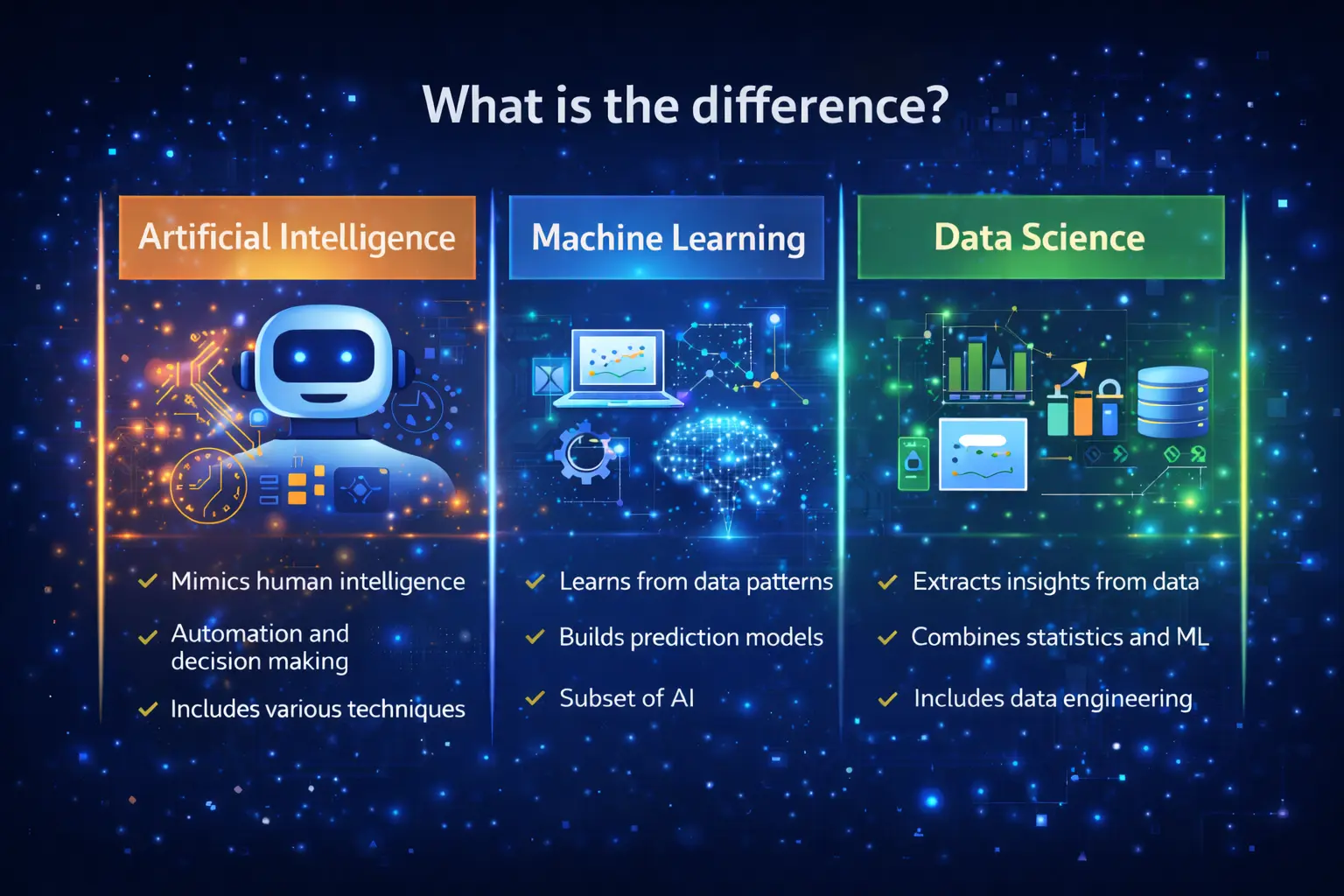
Artificial Intelligence is the broadest concept among the three fields. Artificial Intelligence refers to systems designed to perform tasks that normally require human intelligence. These tasks may include understanding language, recognizing images, making decisions, or solving complex problems. Examples of AI systems include:
- voice assistants such as Siri or Alexa
- recommendation systems used by Netflix and Amazon
- fraud detection systems in banking
- autonomous vehicles
- medical diagnosis tools Early AI systems were often built using rule-based approaches where developers explicitly defined decision rules. For example:
IF temperature > 38°C → possible fever
Modern AI systems increasingly rely on machine learning algorithms, which learn patterns from data rather than relying entirely on predefined rules. Machine learning has therefore become the most powerful technique used in modern artificial intelligence.
2. What Is Machine Learning?
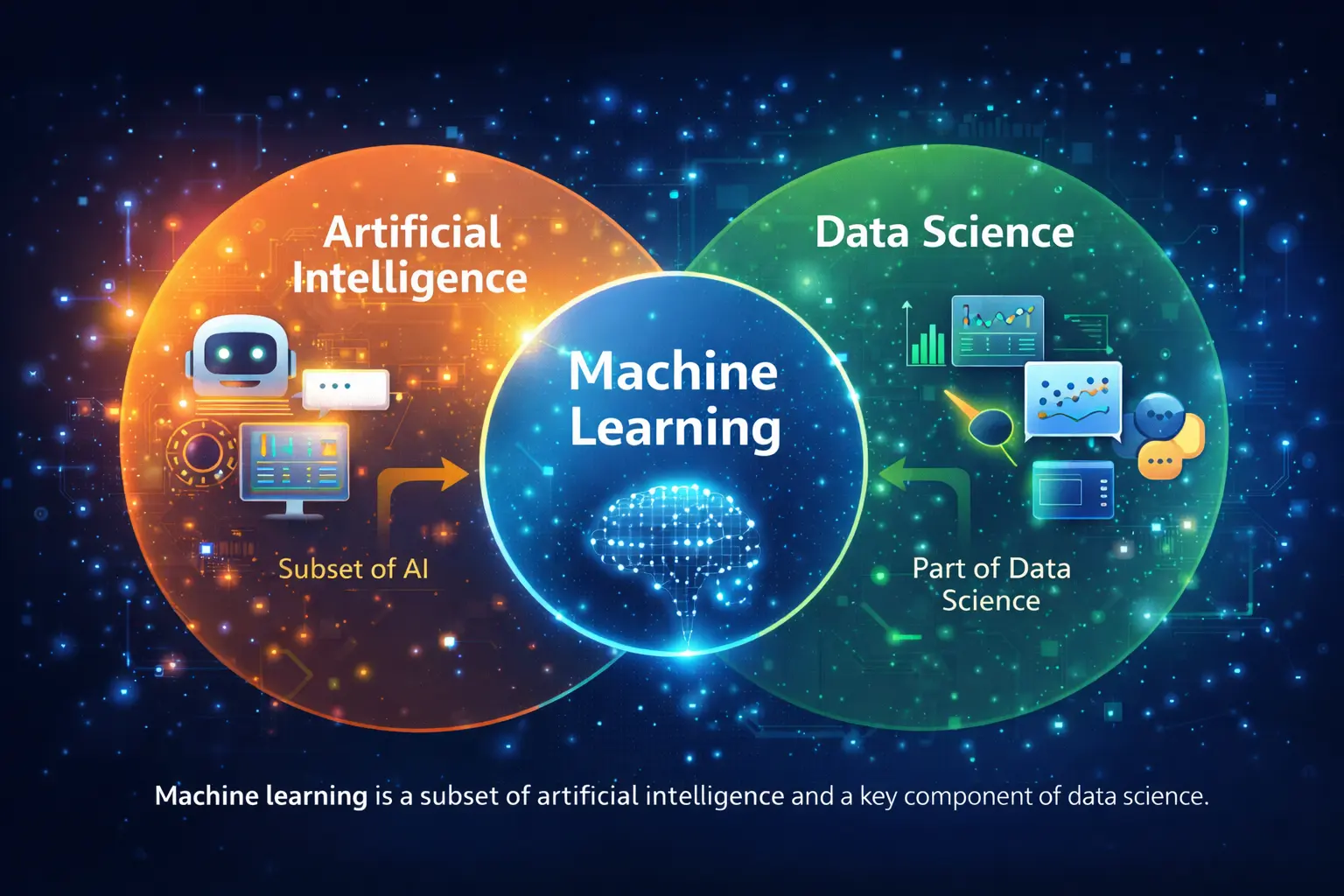
Machine Learning is a subset of Artificial Intelligence focused on algorithms that learn patterns from data. Instead of writing explicit rules, machine learning models are trained using datasets. The model identifies relationships between variables and uses these patterns to make predictions. For example, a machine learning model predicting house prices might learn relationships between:
- property size
- location
- number of rooms
- historical market prices After training, the model can estimate prices for houses that were not included in the training dataset. Machine learning is typically divided into three main categories.
Supervised Learning
Supervised learning uses labeled datasets where the correct output is known. Common examples: spam detection, credit risk prediction, sales forecasting, medical diagnosis. Popular supervised learning algorithms include linear regression, logistic regression, decision trees, random forests, and gradient boosting.
Unsupervised Learning
Unsupervised learning works with unlabeled data. Instead of predicting a known outcome, the algorithm tries to discover hidden patterns or structure in the dataset. Typical use cases: customer segmentation, anomaly detection, clustering, dimensionality reduction. Algorithms such as k-means clustering, hierarchical clustering, and DBSCAN are commonly used in unsupervised learning.
Reinforcement Learning
Reinforcement learning involves agents that learn through interaction with an environment. The system receives rewards or penalties depending on its actions and gradually learns strategies that maximize long-term reward. This approach is widely used in robotics, game-playing AI, and autonomous systems.
3. What Is Data Science?
Data Science is a broader discipline focused on extracting insights and knowledge from data.
It combines several areas: statistics, data analysis, machine learning, data visualization, and programming.
While machine learning focuses primarily on predictive models, data science covers the entire process of working with data.
Typical tasks in data science include: collecting and cleaning datasets, exploratory data analysis, feature engineering, building predictive models, and communicating insights through visualizations
Machine learning is therefore one important component of data science, but data science also involves statistical analysis and data exploration.
4. Machine Learning vs AI vs Data Science (Comparison)
The relationship between these fields can be summarized as follows.
| Field | Main Focus | Example Tasks |
|---|---|---|
| Artificial Intelligence | Building intelligent systems | Chatbots, recommendation engines |
| Machine Learning | Algorithms that learn patterns from data | Prediction models |
| Data Science | Extracting insights from data | Data analysis, modeling |
In simple terms: Artificial Intelligence represents the broader goal of creating intelligent systems. Machine Learning provides many of the algorithms used to achieve this goal. Data Science focuses on understanding and analyzing data to extract insights and build predictive models.
5. How These Fields Work Together
In real-world applications, these fields often overlap. A typical workflow might involve several steps. First, data scientists collect and analyze datasets. They explore patterns in the data and prepare it for modeling. Next, machine learning models are trained to identify relationships and make predictions. Finally, these models are integrated into AI systems that automate decisions or power intelligent applications. For example, a fraud detection system may involve:
- data science techniques to analyze transaction patterns,
- machine learning models to detect anomalies,
- artificial intelligence systems that automatically block suspicious transactions.
6. Tools That Make Machine Learning Easier
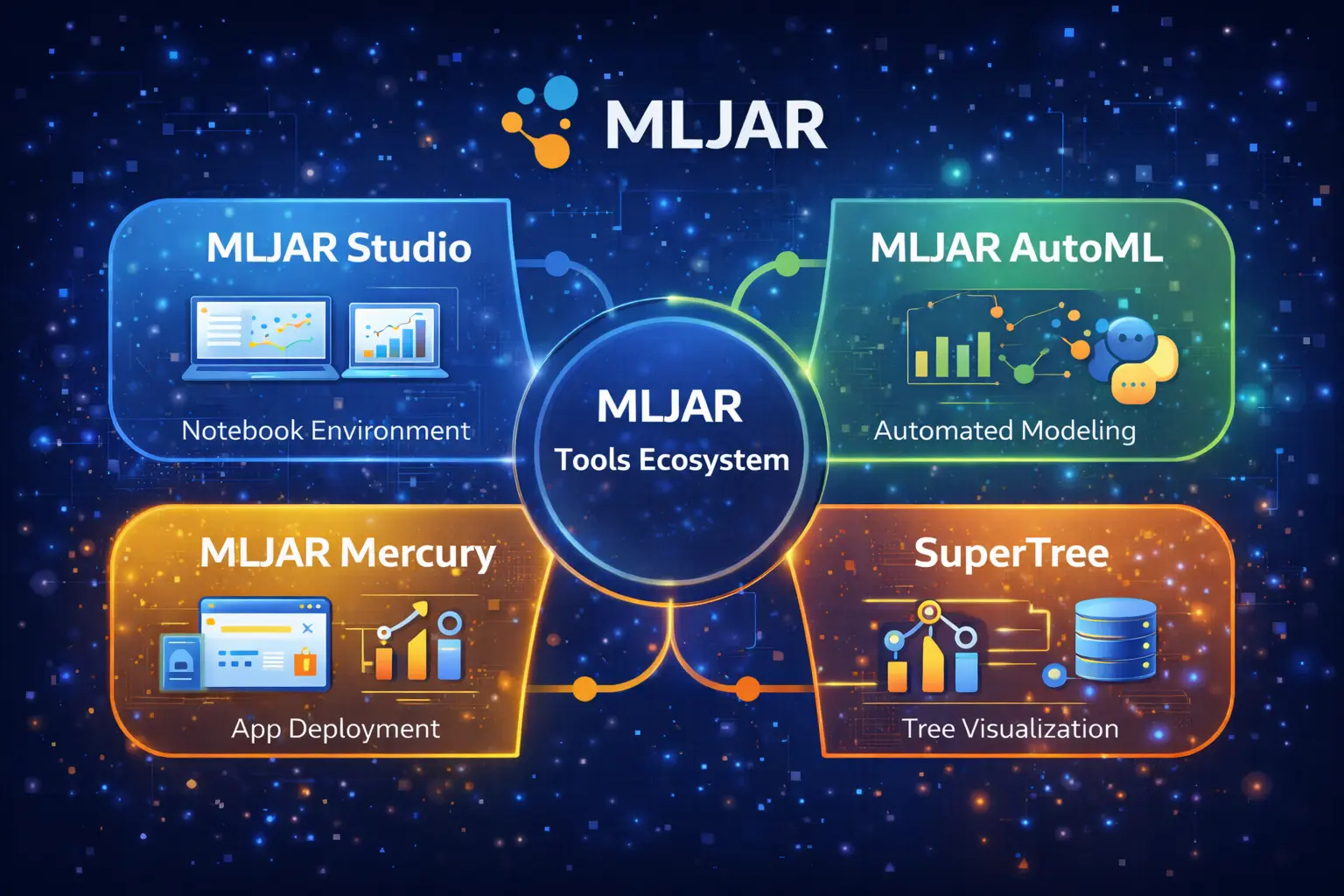
Modern tools have dramatically simplified the process of building machine learning systems. Instead of manually testing many algorithms and tuning parameters, data scientists can use integrated environments and automated tools.
MLJAR Studio
One example is MLJAR Studio, an interactive desktop environment designed specifically for machine learning and data science. MLJAR Studio combines several capabilities in a single tool:
- notebook environment for experimentation,
- automated machine learning,
- integrated AI agent,
- visualization tools. This environment allows users to explore datasets, train models, and generate code with the help of AI.
MLJAR AutoML
Building high-quality machine learning models often requires testing many algorithms and hyperparameters. MLJAR AutoML automates this process by:
- training multiple algorithms
- performing hyperparameter tuning
- comparing model performance
- generating reports explaining results
MLJAR Mercury
Once models are built, results often need to be shared with colleagues or stakeholders. MLJAR Mercury converts Python notebooks into interactive web applications, making it easy to share machine learning models.
SuperTree
Understanding model decisions is important, especially when using decision tree models. SuperTree, an open-source project from MLJAR, provides tools for clearly and interactively visualizing decision trees.
 ## 7. When to Use Each Approach
Each field plays a different role depending on the problem.
Artificial Intelligence is used when building systems that automate complex decision-making.
Machine Learning is used when predictions must be generated from patterns in data.
Data Science is used when analyzing datasets to extract insights and guide business decisions.
In practice, many projects combine all three.
## 7. When to Use Each Approach
Each field plays a different role depending on the problem.
Artificial Intelligence is used when building systems that automate complex decision-making.
Machine Learning is used when predictions must be generated from patterns in data.
Data Science is used when analyzing datasets to extract insights and guide business decisions.
In practice, many projects combine all three.
...
Common Misconceptions
AI and Machine Learning are the same
Machine learning is only one approach within artificial intelligence. AI also includes rule-based systems, robotics, and planning algorithms.
Data Science always involves machine learning
Many data science tasks focus on statistical analysis, visualization, or exploratory data analysis rather than predictive modeling.
Machine learning requires huge datasets
While large datasets can help, many models work well with smaller datasets when features are well designed.
...
Frequently Asked Questions
What is the difference between AI, machine learning, and data science?
Artificial Intelligence is the broad field of building intelligent systems. Machine learning is a subset of AI that learns patterns from data. Data science focuses on analyzing data to extract insights.
Is machine learning part of artificial intelligence?
Yes. Machine learning is one of the main techniques used in artificial intelligence.
Do data scientists always build machine learning models?
No. Data science also includes statistics, data visualization, and exploratory analysis.
What tools help beginners start machine learning?
Interactive environments such as MLJAR Studio make it easier to explore data, train models, and build machine learning workflows.
Final Thoughts
Artificial Intelligence, Machine Learning, and Data Science are closely connected but serve different roles in modern technology. Artificial Intelligence represents the goal of building intelligent systems. Machine learning provides the algorithms that allow systems to learn from data. Data science focuses on extracting knowledge and insights from datasets. Understanding how these fields interact helps developers and analysts build more effective data-driven systems. With modern tools such as MLJAR Studio, MLJAR AutoML, and MLJAR Mercury, getting started with machine learning and data science is easier than ever.
About the Author

Related Articles
- Build a ChatGPT-Style GIS App in a Jupyter Notebook with Python
- Private PyPI Server: How to Install Python Packages from a Custom Repository
- Essential Python Libraries for Data Science (2026 Guide)
- Statistics for Data Science: Essential Concepts
- Machine Learning Basics: Beginner’s Guide 2026
- AI Ethics and Responsible Data Science: Building Fair and Private Machine Learning Systems
- Local vs Cloud Data Processing: Security, Privacy, and Private AI Workflows
- AutoResearch by Karpathy and the Future of Autonomous AI Research
- Complete Guide to Offline Data Analysis 2026
- Data Analysis Software for Pharmaceutical Research
Private AI data analysis
AI Data Analyst on Your Computer
Use MLJAR Studio to explore data, discover insights, and create reports with AI.
Runs locally · Your data stays private